In the marine environment, the ship's hull is constantly affected by salt water, humidity, currents, temperature and organisms such as barnacles, barnacles, moss, algae and other attached organisms. If left unchecked, biofouling can increase friction with water, affecting speed, fuel consumption and hull surface condition.
WHAT IS ANTI-HA PAINTING?
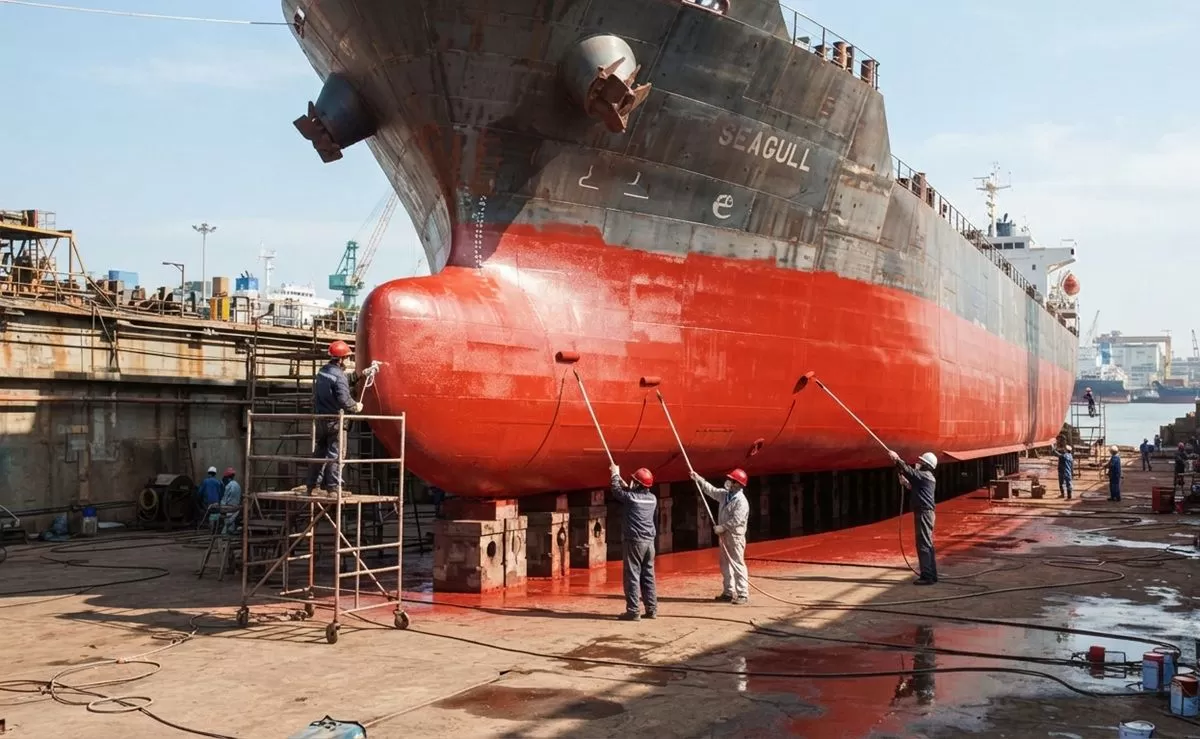
Antifouling paint, also known as antifouling paint, is a specialized paint designed to limit the phenomenon of marine organisms sticking and growing on ship surfaces. Paint is often used in paint systems to protect the hull of a ship below or near the waterline.
Unlike conventional decorative paint, antifouling paint must operate stably in an environment soaked in water for a long time. Depending on the technology, the coating can create a surface that limits the ability of organisms to adhere or control their growth through a mechanism to release appropriate active ingredients.
WHY DO SHIPS NEED TO USE ANTI-HAUL PAINT?
When a ship operates at sea, the body in contact with water is a favorable environment for many types of organisms to grow. Initially, a biofilm may appear, then algae, algae, barnacles and larger organisms can form on the surface.
This layer of organisms makes the surface of the ship's hull rough and increases resistance when the ship moves. For ships operating frequently, this phenomenon can increase the need for engine power and fuel consumption to maintain operating speed.
OPERATION MECHANISM OF ANTIHA PAINTING
The antifouling mechanism depends on the technology and type of paint used. Some coating systems use antifouling active ingredients that are controlled released from the coating, while other technologies focus on creating surfaces with properties that make it difficult for organisms to adhere firmly or to be easily removed when the ship is in motion.
Modern paint systems are often designed to control the release rate of the active ingredient throughout the application period. Thanks to this, protection can be maintained for a certain period of time instead of releasing too quickly immediately after the vessel is placed in the water.
WHAT IS THE DIFFERENT DIFFERENT FROM ANTI-CORROSE PAINT?
Antifouling paint and anticorrosion paint have different functions but are often used in the same ship painting system. Anti-corrosion paint concentrates on protecting steel or metal from the effects of sea water, oxygen and other corrosive agents.
Meanwhile, antifouling paint focuses on limiting the growth of marine life on the surface. Therefore, antifouling paint should not be considered the only coating protecting the hull. A complete paint system usually requires a primer, anti-corrosion layer, intermediate or bonding layer and antifouling layer depending on the manufacturer's design.
TYPES OF ANTI-FOUEL PAINT FOR SHIPS
There are many different antifouling paint technologies on the market, selected depending on the type of ship, operating speed, water area, operating time and maintenance requirements. Some systems use controlled active release technology, while other products use self-polishing mechanisms or special surfaces.
Self-polishing antifouling paint is a popular technology in the marine industry. During vessel operations, the coating is subject to controlled abrasion or hydrolysis, helping to maintain a relatively stable surface and assisting in controlling the rate of antifouling active ingredient release.
In addition, there are antifouling paint systems that do not contain some traditional active ingredients or use special surface technology. The selection should be based on technical requirements, environmental regulations and manufacturer's instructions.
COMPOSITION OF ANTIHA PAINTING
Antifouling paints often include binders, solvents or dispersion media, pigments, fillers and ingredients that provide antifouling properties. Specific ingredients vary significantly by technology and manufacturer.
In particular, antifouling active ingredients need to be strictly controlled because they can affect the water environment. Therefore, product selection needs to consider not only antifouling effectiveness but also the legal and environmental requirements applicable in the area where the ship operates.
ANTI-FOAMING PAINT FOR STEEL HURTS
For ships with steel hulls, the paint system is often designed in multiple layers to protect the metal from the marine environment. The antifouling layer is located on the outermost part of the underwater system and must be compatible with the layers below.
Adhesion between layers is important for system longevity. If the antifouling coating is not compatible with the intermediate coating or the surface preparation is not satisfactory, peeling may occur and the protective effectiveness will be reduced.
SURFACE PREPARATION BEFORE ANTI-FOUEL PAINTING
Surface preparation is one of the factors that determine the quality of a marine painting system. The surface needs to be cleaned of grease, salt, dirt, old damaged paint and impurities that can affect adhesion.
For new painting or maintenance painting, the surface treatment method must be consistent with the actual condition of the hull and the technical requirements of the paint system. After treatment, it is necessary to check cleanliness, roughness and surface condition before proceeding with the next coat of paint.
ANTI-FOUEL PAINT FILM THICKNESS
Dry paint film thickness is an important parameter when applying antifouling paint. If the coating is too thin, the amount of active material and protection may not be as designed. On the contrary, applying too thickly can affect the drying process, adhesion and effectiveness of the system.
Therefore, the thickness needs to be controlled according to product specifications. In professional projects, paint film thickness measuring equipment is often used to check at many different locations on the ship's hull.
SEAWATER RESISTANT
Antifouling paint must maintain stability when exposed to long-term seawater. Water resistance, adhesion and stability of the paint film are important factors affecting the longevity of the coating.
In addition to sea water, the ship's hull is also affected by currents, temperature changes and the process of the ship moving at high speed. Therefore, the product needs to be selected based on actual exploitation conditions instead of just based on parameters in laboratory conditions.
ANTI-HAUL PAINT AND SHIP'S FUEL EFFICIENCY
One of the notable benefits of antifouling systems is to limit the increase in surface roughness caused by marine organisms. When the hull surface is clean and relatively smooth, hydrodynamic drag can be better controlled.
This has implications for operational efficiency, especially for ships that operate frequently and have long operating periods. However, the degree of impact on fuel depends on many factors such as ship type, speed, hull condition, route of operation and level of fouling organisms.
LIFESPAN OF ANTIHA PAINTING
The lifespan of antifouling paint does not have a fixed value for all types of ships. Usage time depends on the type of paint, paint film thickness, ship speed, frequency of operations, sea area, water temperature and level of marine life.
Vessels that are frequently in operation may have different conditions than vessels that are anchored for long periods of time. Therefore, when choosing a product, it is necessary to refer to the protection time announced by the manufacturer and adjust it according to actual exploitation conditions.
FACTORS TO CONSIDER WHEN CHOOSING ANTI-HA PAINTING
The selection of antifouling paint should start from the type of ship and operating conditions. Cargo ships, fishing vessels, service vessels, speedboats and cruise ships can have very different requirements in terms of speed, operating time and maintenance frequency.
In addition, it is necessary to consider the type of base material, existing paint system, construction conditions, time the ship is in dry dock and environmental requirements. A suitable product needs to both meet antifouling requirements and be compatible with the entire hull protection paint system.
ENVIRONMENTAL REGULATIONS FOR ANTI-HAUL PAINT
Antifouling paints are directly related to the marine environment because some technologies use active ingredients that can be released into the water. Therefore, the use of antifouling paint must comply with relevant environmental and marine regulations.
In particular, international regulations on controlling antifouling systems of ships impose requirements on the use of certain substances that have adverse impacts on the environment. Therefore, when choosing products for ships operating internationally, it is necessary to clearly check the product's compliance with current regulations.
APPLY ANTI-HA PAINTING PROPERLY
Antifouling paint application must strictly follow the manufacturer's instructions regarding mixing ratio, application method, thickness, drying time and interval between layers. Improper application conditions can significantly reduce the life of the coating.
Environmental conditions at the time of construction also need to be controlled. Humidity, surface temperature, air temperature and dew point can affect paint film quality. Therefore, checking environmental conditions before and during the painting process is very necessary.
MAINTENANCE AND REPAINTING OF THE HUSBAND
After a period of exploitation, the ship's hull needs to be inspected to assess the condition of the paint layer and the level of attached organisms. Regular maintenance helps detect peeling, cracking, blistering or deterioration of the antifouling layer early.
When repainting, you should not just apply a new layer of paint to the entire surface but need to evaluate the existing paint system. Damaged areas need to be treated appropriately, and compatibility between the new paint layer and the old paint layer should be checked before application.
WHAT TYPE OF ANTI-HAUL PAINT FOR SHIPS IS SUITABLE?
There is no single antifouling paint suitable for all ships. The selection should be based on the type of vessel, operating speed, water area, operating time, dry dock time and environmental requirements.
For vessels regularly operating at sea, paint systems designed for long protection periods and consistent biofouling control may be preferred. Meanwhile, ships operating in specific waters or with long berthing times need to be evaluated individually to choose appropriate technology.
Antifouling paint for ships is an important component in the ship's hull protection system, helping to limit the growth of marine life and maintain surface condition during exploitation. The control of fouling organisms is not only related to coating durability but can also affect the ship's drag, operational efficiency and maintenance costs.
To achieve high efficiency, it is necessary to choose paint suitable for the type of ship and operating conditions, while strictly controlling surface preparation, application, paint film thickness and periodic maintenance. Besides antifouling effectiveness, requirements for safety and protection of the marine environment also need to be considered during the entire process of product selection and use.
>> See more Plastic for ship painting <<
>> See more Plastic for car paint <<
>> See more Resin for anti-rust paint <<
>> See more Epoxy resin <<
MEGA VIETNAM GENERAL TRADING COMPANY LIMITED
Address: Floor 2-A2-IA20, Nam Thang Long Urban Area, Ward. Pham Van Dong, Phu Thuong Ward, City. Hanoi.
Email: contact@megavietnam.vn; Tel: (+84) 24 375 89089;
Website: megavietnam.vn; Hotline: 1800.577.728; Zalo: 0971.023.523