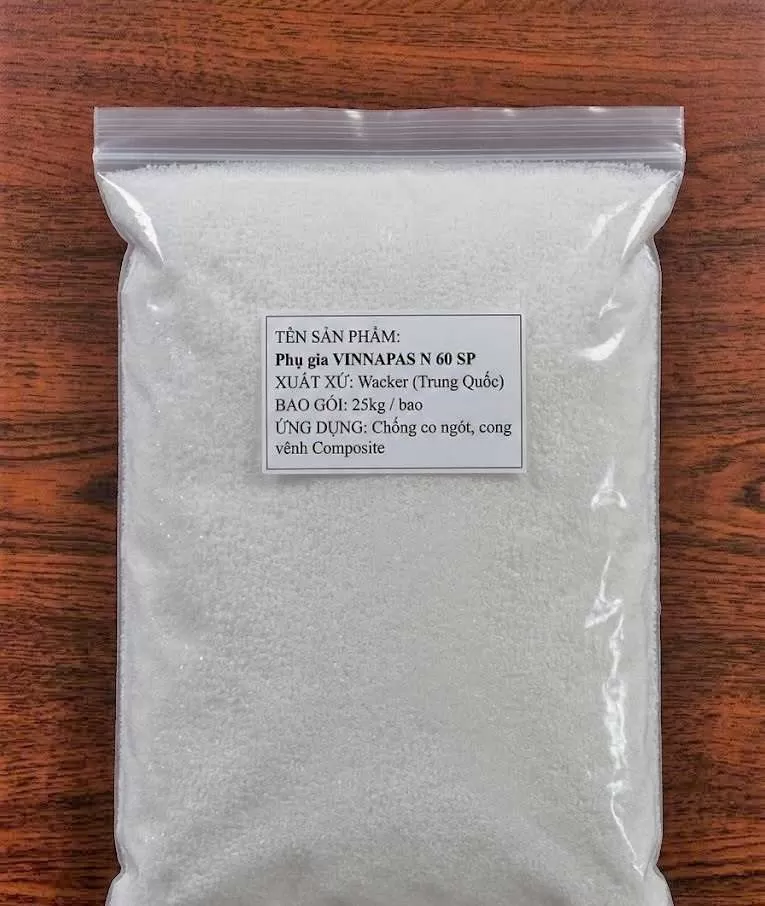
To control this problem, the composite industry uses groups shrinkage reducing additives – Low Profile Additive (LPA). In particular, WACKER's VINNAPAS N 60 SP is a thermoplastic polyvinyl acetate (PVAc) used for the purpose of controlling shrinkage and improving the dimensional stability of composites.
It is worth noting that the effectiveness of VINNAPAS N 60 SP does not just come from "adding a resin" to the formula. The important mechanism lies in the process of dissolution, phase separation and microstructure formation during the curing process, thereby reducing the volume shrinkage of the plastic system and limiting internal stresses that cause product deformation.
WHY DO POLYESTER PLASTIC COMPOSITES SHRINK UP WHEN CURETING?
To understand the mechanism of VINNAPAS N 60 SP, it is first necessary to understand the cause of shrinkage in polyester-based composites.
Unsaturated polyester resin is often mixed with styrene monomer to create a mixture with suitable viscosity for processing. In the presence of an initiator, polymerization and cross-linking reactions take place, forming a thermosetting polymer network.
During this process, the distance between the molecules changes and the system transforms from the initial mixed state to a cross-linked polymer network. As a result, the volume of the resin phase tends to decrease. WACKER says unsaturated polyester resins during the curing process can cause significant shrinkage, which in its literature is described at approximately 6–10% by volume without appropriate control measures.
In real composites, this shrinkage can manifest itself as many types of defects:
- Shrinkage in size after removing the mold.
- Warped or warped details.
- Sink mark on the surface.
- Print glass fiber onto the surface.
- Ripples or surface deformation.
- High internal stress.
- Size deviation compared to the mold.
In particular, when the product has a large shape, thin walls, or uneven material distribution, differences in shrinkage between regions can create internal moments and lead to warping.
ANTI-Shrinkage Mechanism of VINNAPAS N 60 SP
VINNAPAS N 60 SP can initially be dissolved in styrene to form an additive solution before mixing with the resin system. Solid VINNAPAS is soluble in styrene and is used as a solution in styrene when making LPA.
In the initial state, PVAc and the polyester–styrene system can form a sufficiently compatible system to mix relatively homogeneously. However, as polymerization begins, the structure and polarity of the polyester phase change. The compatibility between PVAc and the curing resin phase is reduced, leading to controlled phase separation.
The process can be visualized in the following steps: Homogeneous mixture → curing reaction begins → polyester increases molecular weight → compatibility decreases → PVAc separates from the resin phase → PVAc-rich structure forms → shrinkage compensation mechanism appears.
This is the foundation of the low-profile effect.
HOW DOES PHASE SEPARATION HELP COMPENSATE SHRINKAGE?
During the curing process, the polyester resin phase tends to shrink. Meanwhile, the PVAc-rich phase has a different volume behavior than the thermosetting plastic phase.
When PVAc separates into its own phase, it can create a thermoplastic polymer-rich structure and micro-regions that are able to partially compensate for the volume shrinkage of the curing plastic phase. Studies on the UP/PVAc system show that phase separation and microvoid formation are important mechanisms in shrinkage control of LPA.
In other words, instead of letting the entire plastic system shrink together following the natural tendency of the polymerization process, LPA creates a microstructure that helps reduce the net volume change of the entire composite system.
This is why LPA additives are often called shrinkage reducers or low profile additives, not simply fillers.
THE ROLE OF MICROPHOLES FORMATION
One of the interesting points of the LPA mechanism is the formation of microvoids at certain stages of the curing process.
As the resin system continues to polymerize and shrink, the difference in deformation between the UP phase and the PVAc-rich phase can lead to the formation of microscopic voids in the structure. Studies on the UP/PVAc system show that microvoid is one of the important factors that help compensate for the shrinkage of the plastic phase.
It can be simply visualized: Polyester resin shrinks → PVAc separates into separate phases → microstructure develops → microvoid/LPA-rich phase forms → reduces overall volume shrinkage.
Of course, this is a microscopic mechanism and does not mean that the final product has large pores visible to the naked eye. Actual effectiveness depends on the type of LPA, content used, resin system, styrene, initiator, temperature and curing conditions.
WHY DOES REducing Shrinkage Help Prevent Warping?
Shrinkage and warping are very closely related.
If a composite panel shrinks completely uniformly in all directions, the amount of dimensional change can be controlled relatively easily. But in real products, the distribution of resin, glass fiber, filler, thickness and temperature is not always uniform.
When one region contracts more than another, the difference in deformation creates internal stress. If this stress is large enough, the product may warp, sag or twist after being unmolded and cooled.
By reducing the shrinkage of the plastic phase and making the volume change of the system more stable, LPA helps reduce the source of shrinkage stress. Therefore, VINNAPAS N 60 SP contributes to limiting warping and improving the geometric stability of composite parts. WACKER also identified shrinkage during curing as a possible cause of warping, deformation and dimensional stability problems in composite products.
HOW DOES VINNAPAS N 60 SP HELP IMPROVE COMPOSITE SURFACES?
In addition to controlling size, the low-profile effect is especially important for surface quality.
When the resin shrinks strongly, the difference in deformation between the resin, glass fiber and filler can create concave, wavy areas or cause the image of reinforcing fibers to appear clearly on the surface.
As the shrinkage level is better controlled, the change in surface geometry is also reduced. Therefore, the product can achieve a more flat and uniform surface.
WACKER says VINNAPAS LPA systems can help reduce shrinkage to very low levels and create smooth, uniform, Class-A quality surfaces in the right applications.
This is why LPA is especially important for composite parts where appearance and surface flatness are highly required.
DOES VINNAPAS N 60 SP MAKE COMPOSITE SOFTER?
The mechanism of VINNAPAS N 60 SP should not be understood simply as “composite softening”.
VINNAPAS N 60 SP is a thermoplastic polymer, but when used as an LPA, the main objective is to control shrinkage and micromorphology of the composite system during curing.
VINNAPAS can maintain better mechanical properties than some other shrinkage-reducing admixtures; PVAc polymer remains as a fine distribution in the final product.
However, this does not mean that it can be supplemented at will. LPA content, molecular weight and compatibility with the resin system all affect the final structure and mechanical properties of the composite.
WHAT COMPOSITE SYSTEMS IS VINNAPAS N 60 SP SUITABLE FOR?
VINNAPAS N 60 SP is especially suitable for composite systems where shrinkage and dimensional stability are important issues.
1. Unsaturated polyester resin composite
This is a typical application group of LPA. When unsaturated polyester resins cure with styrene, VINNAPAS N 60 SP can be used to control shrinkage and improve surface quality.
2. SMC and BMC
In SMC - Sheet Molding Compound and BMC - Bulk Molding Compound technology, the requirements for dimensional stability and surface quality are often very high.
LPA is used to reduce shrinkage during the molding process, thereby limiting sink marks, warping and surface defects.
3. Glass fiber reinforced composite
For FRP, the interaction between resin, fiber and filler can create internal stresses during curing. Controlling the shrinkage of the plastic phase is one of the solutions to help improve the geometric stability of the product.
4. RTM and composite molding technologies
VINNAPAS N 60 SP is also introduced for composite systems using RTM technology. In these technologies, viscosity control, miscibility and curing need to be considered at the same time as effective shrinkage reduction.
FACTORS AFFECTING ANTI-Shrinkage Efficiency
VINNAPAS N 60 SP should not be considered a stand-alone solution that can eliminate all causes of warping. Actual effectiveness depends on the entire composite formulation and manufacturing process.
Some important factors include type of polyester resin, styrene content, type and content of LPA, initiator, accelerator, filler, fiberglass ratio, curing temperature, pressing pressure and release conditions.
Studies show that LPA content, molecular weight, curing temperature and phase structure all affect shrinkage control effectiveness. Therefore, the optimal content needs to be determined according to each resin system and technological process instead of applying a fixed ratio to every formula.
For manufacturers of SMC, BMC, FRP, unsaturated polyester composites and parts requiring high dimensional stability, choosing the right LPA and optimizing the amount used can play an important role in Reduce warping, limit surface defects and improve product stability.
VINNAPAS N 60 SP is currently supplied by Mega Vietnam as 100% solid granules, 25 kg bags and is oriented for composite applications that need to control shrinkage, warping and surface quality.
>> See details VINNAPAS N 60 SP <<
>> See more Epoxy resin <<
>> See more Additives for composites <<
MEGA VIETNAM GENERAL TRADING COMPANY LIMITED
Address: Floor 2-A2-IA20, Nam Thang Long Urban Area, Ward. Pham Van Dong, Phu Thuong Ward, City. Hanoi.
Email: contact@megavietnam.vn; Tel: (+84) 24 375 89089;
Website: megavietnam.vn; Hotline: 1800.577.728; Zalo: 0971.023.523