TCVN 2752:2017 – Vulcanized or thermoplastic rubber – Determination of liquid action is a national standard that prescribes a method for evaluating the durability of rubber when exposed to liquids through measuring the properties of the sample before and after immersion testing. This standard is completely equivalent to ISO 1817:2015 and replaces the TCVN 2752:2013 version. According to the national standards portal, TCVN 2752:2017 is currently recognized as valid.
TCVN 2752:2017 REGULATIONS WHAT CONTENTS?
TCVN 2752:2017 was developed to provide a systematic testing method to determine the influence of liquid on vulcanized or thermoplastic rubber. The scope of application includes practical liquids such as petroleum derivatives, organic solvents, chemical agents and standard liquids used in testing.
By comparing the properties of rubber before and after exposure to liquid, the testing laboratory can evaluate the degree of change in the material under specified conditions. The results help businesses choose the type of rubber suitable for the working environment, while also providing data for research, development and product quality control.
In terms of structure, the standard includes main contents related to equipment and instruments, calibration, selection of test liquid, sample preparation, sample immersion, test conduct, precision and reporting results. In addition, the standard also has appendices regulating standard liquids and equipment calibration plans.
WHY IS IT NECESSARY TO DETERMINE THE IMPACT OF LIQUID ON RUBBER?
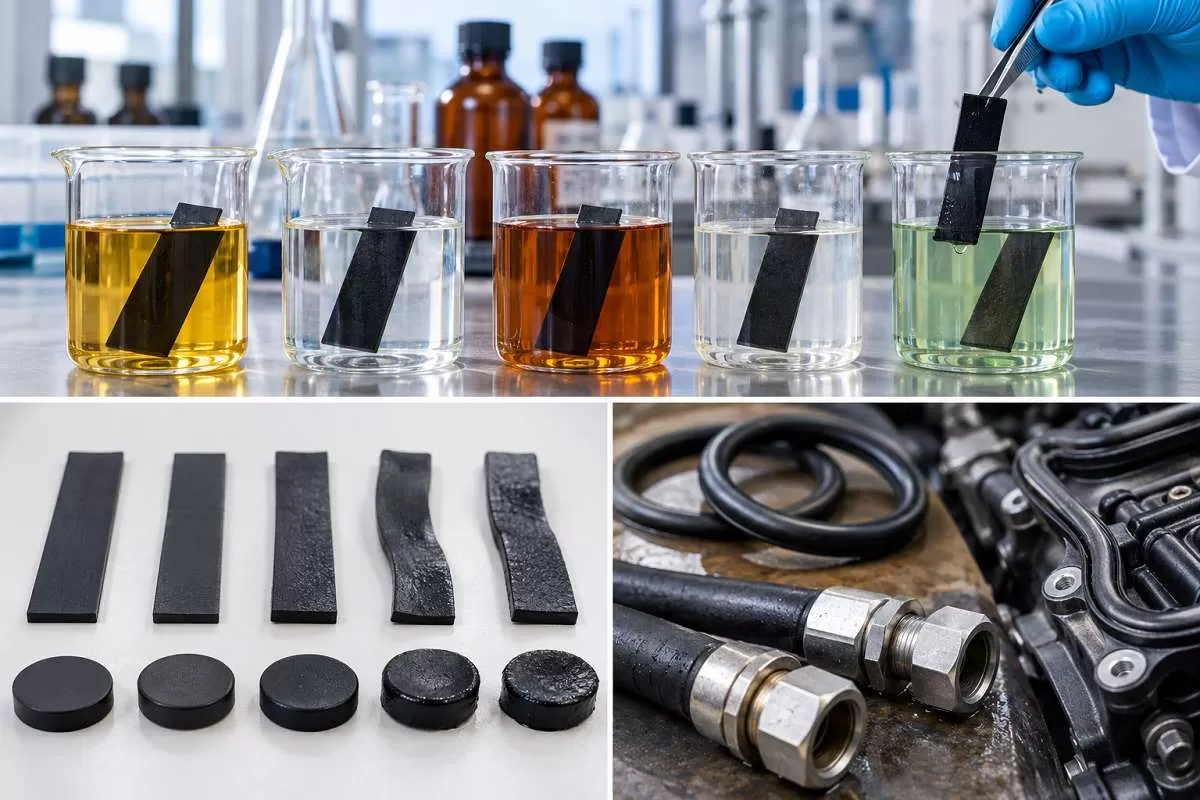
Rubber can be affected by liquids by many different mechanisms. Liquids can be absorbed into the material, components in the rubber can be dissolved and extracted, or a chemical reaction can occur between the liquid and the material. These phenomena can occur simultaneously, depending on the rubber composition and the nature of the contact environment.
One of the common phenomena is swelling, which occurs when rubber absorbs liquid and the volume of the material increases. This change can affect the assembly dimensions, tightness and performance of gaskets, seals, pipes or elastic parts. In some cases, the liquid also changes the hardness and mechanical properties, causing the product to no longer meet the original usage requirements.
Therefore, assessing fluid resistance not only helps determine the degree of swelling but also assists in identifying other important changes in the material. This is the basis for comparing rubber types, choosing appropriate materials and limiting the risk of damage during operation.
INDICATORS OF INTEREST WHEN TESTING ACCORDING TO TCVN 2752:2017
Evaluation according to TCVN 2752:2017 is based on properties suitable for the testing purpose and requirements of the material. Results of common interest include changes in mass, volume, size, hardness and tensile properties of rubber before and after contact with liquid.
Changes in mass and volume help identify the extent of liquid absorption or loss of extractable components from the material. Meanwhile, hardness and tensile stress-elongation properties provide information about mechanical changes, such as the material becoming softer, stiffer or reducing its ability to withstand deformation.
Not every test needs to evaluate all of the above criteria. The selection of criteria, test conditions and measurement methods should be based on the standard content, rubber type, test liquid and evaluation goals. When comparing results between samples, it is necessary to ensure corresponding testing conditions to avoid making erroneous conclusions about the chemical resistance of the material.
BASIC TESTING PROCEDURE ACCORDING TO TCVN 2752:2017
The testing process begins with preparing the rubber sample according to the regulations on sample size, state and stability conditions. Test fluids are selected based on actual usage environments or specific evaluation requirements. Measuring equipment and testing tools need to be properly checked and calibrated to ensure the reliability of results.
Next, the rubber sample is immersed in the liquid according to the specified conditions of the test. Factors such as liquid type, temperature, contact time and sample arrangement can significantly influence the results and should be controlled according to the method of application. After completing the soaking process, the sample is processed according to the corresponding procedure before carrying out the necessary measurements.
Finally, the post-test measurement results are compared with the initial values to determine the degree of change in the material. The test report should show complete information about the sample, liquid, test conditions, measurement method and results obtained. Complying with the process helps parties have a clearer technical basis when evaluating, comparing or choosing rubber materials.
APPLICATION OF TCVN 2752:2017 IN INDUSTRY
In the automotive and mechanical industries, the standard can be used as a basis for testing rubber materials for gaskets, seals, pipes and other components that may come into contact with lubricating oils, fuels or operating fluids. Test results assist in assessing the suitability of materials for the working environment and reduce the risk of dimensional variation or performance deterioration during use.
In the chemical industry and industrial equipment manufacturing, this test method is significant for rubber parts exposed to solvents, chemicals or technological fluids. Liquid resistance testing helps businesses have more data to choose materials for piping systems, seals and equipment that need to maintain stability under specific operating conditions.
For rubber product manufacturers, TCVN 2752:2017 can also be used in materials research, comparing mixing formulas and checking quality between production batches. However, the results of testing according to this standard do not automatically mean that the product has met all technical requirements or is certified suitable for a particular application.
BENEFITS OF APPLYING TCVN 2752:2017 IN QUALITY CONTROL
Applying a unified testing method helps businesses evaluate the liquid resistance of rubber based on measurement data instead of relying solely on material description information. This is especially useful when choosing between a variety of rubbers with different compositions, structures and properties, or when it is necessary to check the suitability of the material for the actual use environment.
In addition, the test results can assist in determining the cause of swelling, change in hardness or deterioration of mechanical properties after exposure to liquid. This is an important source of information for improving material formulations, selecting raw materials and developing quality control requirements suitable for each product.
To ensure accuracy, businesses need to choose the correct version of the standard, prepare appropriate samples, use controlled equipment and fully document testing conditions. When it is necessary to draw conclusions about long-term usability, results according to TCVN 2752:2017 should be considered along with other technical requirements and tests related to the working conditions of the product.
NOTES WHEN APPLYING TCVN 2752:2017 STANDARDS
Before conducting testing, it is necessary to clearly identify the type of rubber, composition or material code, contact fluid and purpose of evaluation. Test results with one oil or solvent should not be used to generalize directly to all other fluids, because the degree of interaction depends on both the rubber structure and the chemical properties of the contact medium.
In addition, laboratory testing conditions do not always fully reflect actual usage conditions. Temperature, contact time, pressure, mechanical impact and changes in fluid composition during operation can change the degree of impact on the material. Therefore, the interpretation of results needs to be linked to the technical requirements of the specific application.
Enterprises and testing laboratories should refer to the full text of TCVN 2752:2017 to determine the exact process, testing conditions and reporting requirements. When it is necessary to evaluate specific properties such as tensile strength, hardness or tear strength, it may be necessary to combine the corresponding test standards instead of relying on a single test.
LOOK UP AND USE TCVN 2752:2017
TCVN 2752:2017 is an important reference document for rubber manufacturers, technical detail manufacturers, testing laboratories and quality control departments that need to evaluate the impact of liquids on rubber materials. Looking up the correct standards helps unify test methods, improve data reliability and support the material selection process for each working environment.
Users can look up information about model numbers, names, validity status and scope of application on the National Standards Portal. Before use in technical documents or quality control procedures, it is advisable to check the update status of the standard and refer to the full version to ensure correct application of the relevant requirements.
TCVN 2752:2017 – Vulcanized or thermoplastic rubber – Determination of liquid action provides a technical basis for evaluating changes in rubber after contact with oils, solvents and other liquids. Through the examination of pre- and post-test properties, the standard supports material selection, quality control and research to improve rubber products.
For businesses and testing laboratories, correctly applying TCVN 2752:2017 contributes to improving the consistency of assessment results and supports making appropriate technical decisions. However, the final material selection still needs to be based on actual usage conditions, product requirements and relevant standards.
>> See more Promote vulcanization <<
>> See more Additives for rubber <<
>> See more Epoxy resin <<
MEGA VIETNAM GENERAL TRADING COMPANY LIMITED
Address: Floor 2-A2-IA20, Nam Thang Long Urban Area, Ward. Pham Van Dong, Phu Thuong Ward, City. Hanoi.
Email: contact@megavietnam.vn; Tel: (+84) 24 375 89089;
Website: megavietnam.vn; Hotline: 1800.577.728; Zalo: 0971.023.523