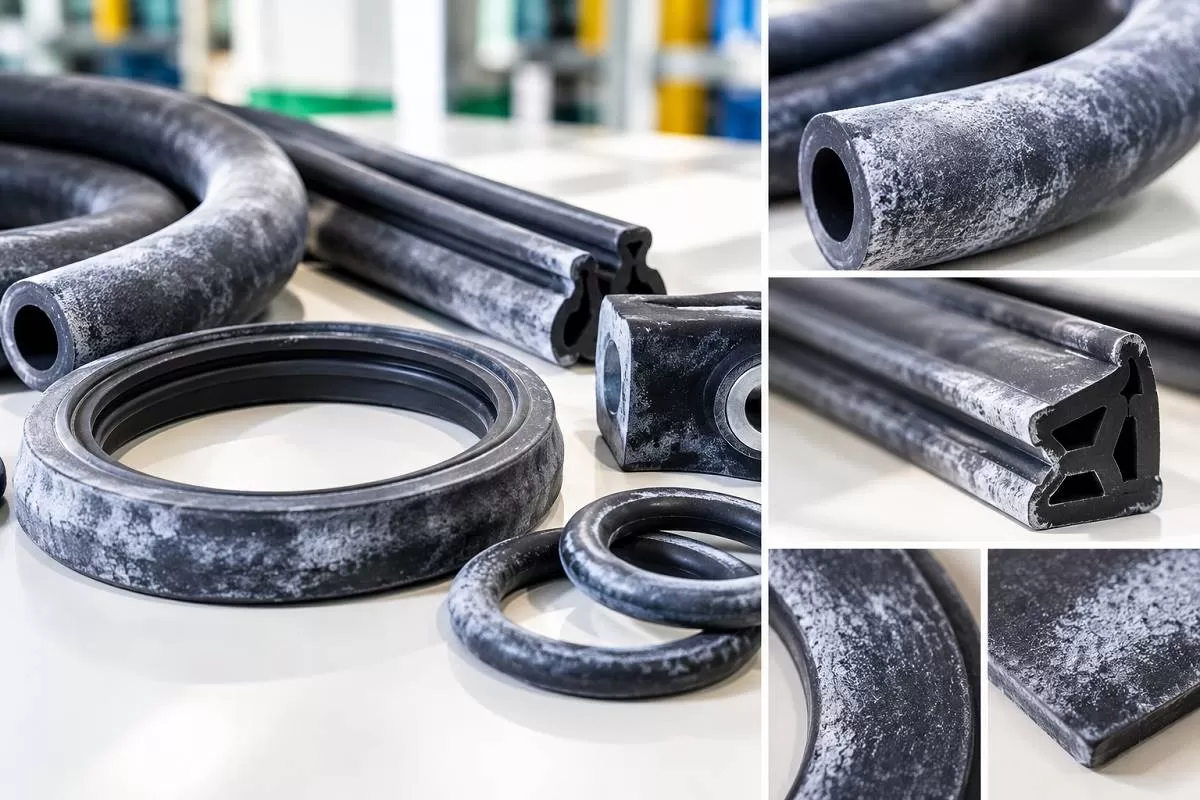
One of the possible causes of this condition is blooming - the phenomenon of components in rubber compounds moving to the surface and accumulating into a coating. However, not all white powder layers on rubber are blooming. Determining the correct cause is an important step before adjusting the formula or adding additives.
So what is blooming in rubber, why does this phenomenon occur after vulcanization and how should businesses handle it to limit recurring errors?
WHAT IS BLOOMING IN RUBBER?
Blooming is the phenomenon of one or more components in the rubber mixture moving from the inside to the surface, then accumulating into a layer of residue, crystals, opaque film or coating with a different color from the original surface. In many cases, the buildup is white or light gray in color so it can easily be mistaken for dirt.
Ingredients that can cause blooming include certain vulcanizers, vulcanization accelerators, anti-aging agents, protective waxes, lubricants and other additives that have the ability to migrate within the polymer matrix. Depending on the chemical nature and conditions of use, the blooming layer may appear immediately after vulcanization or only form after a period of storage.
Blooming needs to be distinguished from the phenomenon of additives being actively applied to the surface to create a protective effect, such as some anti-ozone waxes. In this case, the presence of wax on the surface may be part of the intended protection mechanism, not necessarily a technological defect.
The level of blooming is also not the same between types of rubber. Mixing composition, polymer type, degree of vulcanization, temperature, storage time and compatibility between materials can all influence this phenomenon.
WHY DOES A WHITE POWDER LAYER APPEAR IN RUBBER AFTER VULCULATION?
1. Additive content exceeds compatibility with rubber substrate
This is a reason to consider when the product appears white powder after vulcanization. Some additives are only able to dissolve or disperse stably in the rubber matrix to a certain limit. When the concentration exceeds the appropriate level, the residue can migrate to the surface and crystallize or accumulate as a residue.
For example, some vulcanization accelerators, anti-aging agents or lubricants can cause blooming if used inappropriately with the rubber system. However, it is impossible to conclude based on the name of the additive group alone, because the level of compatibility also depends on the chemical structure, temperature, mixing ingredients and accompanying ingredients.
Therefore, when errors appear after increasing additive content or changing formulas, businesses should compare mixing data and recheck the content used before adjusting other ingredients.
2. Choose an additive that is not suitable for the type of rubber
Natural rubber (NR), styrene-butadiene rubber (SBR), nitrile rubber (NBR), ethylene-propylene-diene rubber (EPDM) and other rubbers have different chemical properties. An additive that works well in one system may not have equivalent compatibility in another system.
If the additive is not compatible with the base polymer, the potential for migration and accumulation on the surface may increase. This issue needs even more attention when businesses change rubber types, raw material suppliers or combine multiple polymers in the same formula.
The choice of additive therefore needs to be based on the specific rubber system, product technical requirements and compatible test data, rather than solely on cost or generally described uses.
3. Vulcanization conditions change the state of the rubber compound
Vulcanization temperature and time affect the reaction rate, the degree of bond formation and the final state of the rubber compound. When the vulcanization mode is not appropriate, the product may have uneven properties or have unusual surface manifestations.
In some systems, thermal conditions can affect the solubility, diffusivity and migration of the additive. However, it should not be assumed that all blooming is due to overheating or lack of cure time.
To accurately evaluate, it is necessary to compare the vulcanization curve, if any, the actual temperature of the mold, vulcanization time and the mechanical properties of the product after completing the process.
4. Storage temperature and time promote admixture migration
Blooming may not appear immediately after removing the product from the mold. Some components take time to diffuse to the surface and accumulate in sufficient quantities to be observed with the naked eye.
High storage temperatures can increase the diffusion rate of some substances. Conversely, temperature changes during storage can also affect the solubility and crystallization of ingredients. Therefore, defects may appear in products that initially meet the requirements but become apparent after a period of storage.
Businesses should note the time of blooming, storage conditions and differences between products in storage locations to find a relationship with the storage environment.
5. The vulcanization system and additives interact with each other
In rubber, vulcanizers, accelerators and supporting components are often used in a coordinated system. Changing one component can affect the reaction rate, dispersion state, or compatibility of the remaining components.
A formula that uses many individual additives does not necessarily bring better results than a formula that is optimized together. If the ingredients are incompatible or the combination ratio is not appropriate, the risk of surface residue may increase.
Therefore, when dealing with blooming, you should not just focus on one additive and ignore the entire mixing system. The evaluation should simultaneously consider the base polymer, vulcanization system, fillers, anti-aging agents and technological additives.
HOW TO DISTINGUISH BLOOMING FROM DIRT AND AGING RUBBER?
The white layer on rubber can originate from many different mechanisms. Preliminary discrimination helps businesses choose appropriate testing methods and avoid adjusting formulas in the wrong direction.
|
Token |
Blooming |
External dirt or residue |
Aging, surface deterioration |
|
Time of appearance |
May appear after vulcanization or after storage period |
May appear immediately after production, transportation or use |
Usually increases over time or environmental conditions |
|
Morphology |
Powder, crystal, matte film or surface coating |
Dust, particles or residue from the environment |
May change color, crack, harden, lose elasticity or crack the surface |
|
After cleaning |
Can reappear if the underlying cause has not been treated |
It may go away if it's just regular dirt |
Not completely restored just by wiping the surface |
|
How to confirm |
Analyze residue composition and check formula |
Check the environment, packaging and cleaning procedures |
Evaluate mechanical properties, appearance and degree of material deterioration |
The above table is for guidance only. Blooming and aging can occur together, and some external residues have a morphology very similar to crystalline additives. The chemical nature of the white layer should not be determined solely by its color or ability to be wiped clean.
If it is necessary to confirm the cause, residue samples can be taken for analysis using appropriate techniques such as Fourier transform infrared spectroscopy (FTIR), microscopy or other chemical analysis methods depending on laboratory conditions.
WHAT INFLUENCE DOES BLOOMING RUBBER HAVE ON PRODUCT QUALITY?
Affects appearance and commercial value
A white powder or opaque film can make the product look old, dirty or uneven. For products that require beautiful surfaces such as shoe soles, colored rubber parts, consumer products and technical components, this can be the reason why the product is rejected by customers.
Affects coating, printing and bonding capabilities
When additives accumulate on the surface, they can form an intermediate layer that changes surface properties and wettability. Depending on the chemical composition of the blooming layer, the adhesion of paint, ink or glue may be impaired.
This is an especially important issue with rubber products that need to be joined, glued with other materials or finished with coatings. Cleaning the surface before painting or gluing may be necessary, but a method must be chosen that is appropriate to the type of rubber and the adhesive or paint system being used.
Affects stability during storage and delivery
If blooming continues after cleaning, the business may have to reprocess the product, change the packaging or extend the pre-shipment inspection period. This increases labor costs, production time and the risk of quality complaints.
On the other hand, not all blooming phenomena significantly reduce the mechanical properties of rubber. The level of influence should be assessed according to the type of additive, usage requirements and actual test results.
HOW TO HANDLE BLOOMING IN RUBBER
Step 1: Determine the nature of the white layer
First, it is necessary to confirm whether the white layer is really blooming or not. Observation of appearance, time of appearance, reappearance after wiping, and differences between product batches can provide initial information.
If the defect affects quality or occurs on a large scale, samples should be taken for residue analysis. Correct identification of the blooming agent helps avoid formula changes based on guesswork.
Step 2: Review formula and ingredient records
Compare the content of each additive, batch number of ingredients, supplier and recent changes in the mixing process. Pay special attention to ingredients that are likely to migrate or crystallize on the surface.
If blooming begins after changing a material, a comparative test should be carried out between the new material and the approved material, under controlled mixing and vulcanization conditions.
Step 3: Check the vulcanization mode
Evaluate temperature, curing time and uniformity between mold positions or production batches. When appropriate equipment is available, rheological data can be used to determine the appropriate vulcanization regime for the rubber system.
Do not arbitrarily increase the temperature or prolong the vulcanization time with the aim of removing the white layer, because improper adjustment may cause thermal aging or deterioration of other properties of the product.
Step 4: Optimize the content and additive system
If testing confirms that blooming is related to additives, businesses can reassess the amount used, compatibility with the base polymer, and the combination of ingredients.
Solutions may include adjusting the additive content, selecting a product grade with better compatibility, or changing the additive combination. All adjustments should be controlled and monitored for important parameters such as hardness, tensile strength, elongation, elasticity and aging resistance.
Step 5: Control storage conditions
The product should be stored in conditions consistent with the requirements of the material and the manufacturer's recommendations. Avoid exposing the product directly to heat sources, sunlight or environments that may cause contamination.
For products sensitive to blooming, businesses should develop a visual inspection process according to storage time and monitor control samples before delivery. Proper packaging also helps limit dust from the outside, although it cannot replace treating the cause of blooming from inside the material.
SHOULD I CLEAN THE WHITE POWDER LAYER ON RUBBER?
Wiping may be a temporary bond treatment if the cleaning method is compatible with the product. However, if the underlying cause persists, the white layer may reappear after a while.
Do not arbitrarily use strong solvents or untested detergents, because they can swell, extract additives, change color or affect rubber surface properties.
For products requiring coating, printing or bonding, cleaning procedures should be confirmed by adhesion and material compatibility testing. For products used in special environments, cleaning and storage instructions specific to that application should be followed.
HOW TO LIMIT BLOOMING RIGHT FROM THE FORMULA DESIGN STAGE?
Prevention is often more effective than treating the product after it has been vulcanized. Enterprises should start from choosing the appropriate additive system for the type of rubber, confirming the content used and evaluating compatibility under actual production conditions.
Besides, it is necessary to standardize the process of weighing raw materials, mixing and vulcanizing; maintain batch traceability records; At the same time, develop a program to evaluate the appearance after storage. Time-based tests help identify slow blooming phenomena that testing immediately after vulcanization may miss.
For new formulations or when changing suppliers, small sample testing should be performed before moving to mass production. The evaluation should not stop at the initial appearance but should also consider the product's ability to maintain mechanical properties and surface finish requirements.
CHOOSE SUITABLE RUBBER ADDITIVES AT MEGAVIETNAM
To limit blooming, the choice of additives should be based on the type of rubber, vulcanization system, processing conditions and end-use requirements. There is no single additive that fits all formulations or can eliminate all blooming.
MegaVietnam provides industrial raw material information serving the rubber, plastic and paint sectors. When choosing additives for rubber, businesses should compare technical documents, usage instructions and compatibility data of each product before testing in the formula.
If you are experiencing a situation where rubber appears white powder after vulcanization, businesses should start by determining the nature of the residue, reviewing the formula and checking storage conditions. From there, the adjustment of the new additive system has a technical basis and limits the risk of new errors.
Blooming is the phenomenon of components in rubber compounds moving and accumulating on the surface, which can form a white powder layer, crystals or translucent film after vulcanization. This phenomenon may be related to additive compatibility, mixing content, vulcanization conditions and storage environment.
For effective treatment, businesses need to distinguish blooming from dirt and material aging, identify defective ingredients when necessary, and then test formulas and processes with controlled trials. This approach helps improve visual stability, limit error recurrence, and better control rubber product quality.
Note: Adjusting the formula, selecting additives or cleaning methods should be based on the type of rubber, technical requirements and actual test results.
>> See more Additives for rubber <<
>> See more Promote vulcanization <<
>> See more Filler powder for rubber <<
>>See more Plastic for industrial paint <<
>> See more Epoxy resin <<
MEGA VIETNAM GENERAL TRADING COMPANY LIMITED
Address: Floor 2-A2-IA20, Nam Thang Long Urban Area, Ward. Pham Van Dong, Phu Thuong Ward, City. Hanoi.
E-mail: contact@megavietnam.vn; Tel: (+84) 24 375 89089;
Website: megavietnam.vn; Hotline: 1800.577.728; Zalo: 0971.023.523