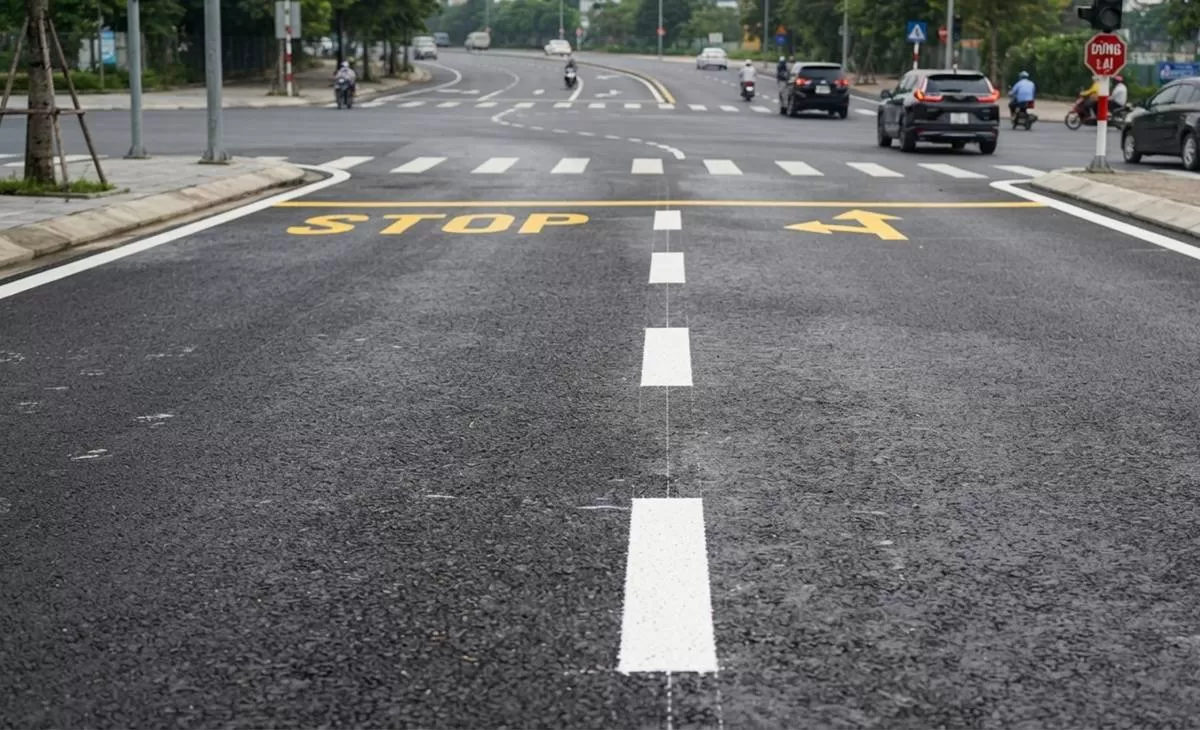
The selection and construction of traffic signal painting should be based on the type of road surface, traffic conditions, operating time requirements as well as current technical standards. For traffic projects such as urban roads, national highways, expressways, airports, parking lots and industrial parks, controlling paint quality and construction process plays an important role in ensuring signal recognition both day and night.
WHAT REQUIREMENTS DO TRAFFIC SIGNAL PAINT MUST MEET?
One of the most important requirements for traffic signal painting is the ability to create clear markings and maintain characteristics under actual operating conditions. The paint layer must adhere firmly to the road surface, not peel off prematurely and be able to withstand the impact of traffic, water, dirt, temperature and weather factors.
Depending on the type of product, traffic signal paint can be produced in the form of solvent paint, water-based paint, thermoplastic paint or other specialized material systems. Each type has different technical requirements and construction methods, so quality should not be evaluated solely based on color or initial coverage, but the entire technical characteristics of the product should be considered.
1. Requirements for color and recognition
The color of traffic signals must ensure clear recognition in different lighting conditions. White is often used for lane markings and many types of instructions, while yellow is used for some types of markings that have a warning or traffic regulation function.
During use, the paint color needs to be able to remain relatively stable under the influence of sunlight, temperature and environment. Excessive discoloration, discoloration or color change can reduce the driver's ability to recognize the vehicle, especially on roads with heavy traffic.
2. Adhesion of traffic signal paint
Adhesion is one of the important criteria that determines the longevity of the paint layer. Paint must bond well with the surface of cement concrete or asphalt concrete, while limiting peeling, cracking or delamination when subjected to mechanical impact.
However, adhesion does not only depend on the paint material itself. Road surface condition, cleanliness, dryness, temperature, humidity and surface preparation methods all have a significant influence on construction results. Therefore, a paint product with good specifications can still quickly degrade if the substrate surface is not treated properly.
3. Abrasion resistance
Painted lines on the road surface are constantly affected by tires, braking forces, sliding forces and dynamic loads. Therefore, abrasion resistance is a particularly important requirement for traffic signal paint used on roads with high traffic volume.
Paint with good abrasion resistance will maintain line thickness and shape for a longer period of time. For areas subject to heavy loads such as intersections, lanes with frequent braking or acceleration, highways and industrial areas, choosing materials with suitable abrasion resistance will help reduce the frequency of maintenance and repainting.
4. Weather resistance and UV resistance
Traffic signal paint is used outdoors and is subject to constant exposure to ultraviolet radiation, rain, temperature and humidity. Especially in areas with high solar radiation intensity, UV rays can accelerate the aging process of adhesives and change the color of the paint layer.
Weather resistance is therefore an important criterion when evaluating the longevity of paint. Quality products need to maintain color, adhesion and mechanical properties under environmental conditions consistent with the range of uses announced by the manufacturer.
5. Reflectivity of traffic signal paint
For road traffic signal systems, the ability to recognize at night is especially important. Traffic signal paint can be combined with reflective glass beads to increase the ability to reflect light from the vehicle's headlights back to the driver.
Reflective effectiveness depends on the type of glass beads, particle size, application rate, spreading method and the depth at which the beads are located in the paint layer. Therefore, technical requirements do not only lie in the paint itself but are also related to the material system and the complete line creation process.
6. Requirements for paint layer thickness
The paint layer thickness must be consistent with the type of material and construction method. If the paint layer is too thin, coverage and durability may not be satisfactory; On the contrary, too thick a paint layer can increase material consumption and affect surface quality.
For thermoplastic paints, thickness requirements are often significantly different from those for liquid paints. Therefore, when accepting, it is necessary to compare with the product's technical records, the project design and the standards or regulations applied to the item.
7. Dryness requirements and time to put into operation
Another important characteristic of traffic signal paint is the drying or curing time after application. Roads often cannot be blocked for long periods of time, so materials need to be in a stable enough state to be put into operation in a suitable time.
Actual drying time depends on paint type, temperature, humidity, coating thickness, ventilation conditions and application method. When constructing in the field, do not rely solely on the theoretical drying time in the product documentation, but consider specific environmental conditions.
8. Requirements for the surface before construction
The quality of the paint line depends greatly on surface preparation. The surface needs to be cleaned of dust, grease, sand and impurities that can affect the adhesion of the material.
For new road surfaces, it is necessary to check the surface condition and conditions for applying the paint layer. For old road surfaces, it is necessary to remove old layers of peeling paint or dirt on the surface. In case of necessity, suitable cleaning or surface treatment may be required before painting.
9. Control construction conditions
Environmental temperature and humidity have a direct impact on the film formation, drying and adhesion process of paint. If applied when the surface is too damp or water is present, the paint layer may lose adhesion and quickly degrade.
Besides, construction speed, spray pressure, material flow, line width and amount of reflective particles also need to be controlled. For projects with high technical requirements, inspection of input materials and control of construction parameters at the site should be performed synchronously to ensure the stability of the paint marking system.
TECHNICAL STANDARDS AND QUALITY RECORDS
When choosing to paint traffic signals for a project, it is necessary to clearly determine the applicable standards, regulations or technical requirements. Depending on the type of project and the investor's requirements, the product may have to meet national standards, industry standards, international standards or specific technical requirements specified in design documents and bidding documents.
Product quality records should clearly show the origin, ingredients or adhesive system, color, physical and mechanical criteria, construction instructions, storage conditions and scope of use. This is an important basis for controlling materials from warehouse receipt to project acceptance.
INSPECTION AND ACCEPTANCE OF TRAFFIC SIGN PAINT
Acceptance work should not be based solely on observing the color of the paint lines. Depending on the project's requirements, it is necessary to check the shape, size, position, uniformity, adhesion, thickness, reflective ability and other criteria specified in the technical documents.
For traffic works with high requirements, testing should be carried out according to corresponding testing standards. Test results need to be compared with approved technical requirements to determine whether the paint layer meets acceptance conditions or not.
FACTORS AFFECTING THE LIFESPAN OF TRAFFIC SIGN PAINT
The lifespan of painted lines not only depends on the quality of paint but is also influenced by traffic volume, vehicle type, vehicle speed, weather conditions, road surface quality and construction process. Areas with high vehicle density or frequently subjected to high braking and friction forces often experience faster wear and tear rates.
In addition, choosing the wrong type of paint or not suitable for the road surface can also significantly reduce longevity. Therefore, it is necessary to choose materials based on actual exploitation conditions instead of just based on price or product parameters in laboratory conditions.
SHOULD I CHOOSE TRAFFIC SIGN PAINT ACCORDING TO COST?
Cost is a factor to consider but should not be the only criterion when choosing traffic signal paint. A product that has a low initial purchase price but wears out quickly, quickly loses color, or has to be reapplied many times can increase total maintenance costs throughout the life of the project.
The right solution is to simultaneously evaluate material quality, expected service life, construction conditions, traffic flow and maintenance costs. This approach helps to choose a paint system that is more suitable to the technical requirements and economic efficiency of each project.
Technical regulations for traffic signal paint do not only focus on color but include many factors such as adhesion, abrasion resistance, weather resistance, reflectivity, thickness, drying time and requirements for the construction surface. Synchronized control of these factors plays a decisive role in the durability and recognition of the signal system on the road surface.
When choosing traffic signal painting, businesses and construction units should base it on the standards applicable to each project, environmental conditions and actual traffic flow. At the same time, it is necessary to control both the quality of input materials and the construction process so that the paint layer achieves long-term effectiveness.
>> See more C5 Hydrocarbon Resin for road paint <<
>> See more C9 Hydrocarbon Resin <<
>> See more Prevents warping of composites <<
MEGA VIETNAM GENERAL TRADING COMPANY LIMITED
Address: Floor 2-A2-IA20, Nam Thang Long Urban Area, Ward. Pham Van Dong, Phu Thuong Ward, City. Hanoi.
Email: contact@megavietnam.vn; Tel: (+84) 24 375 89089;
Website: megavietnam.vn; Hotline: 1800.577.728; Zalo: 0971.023.523