However, when looking deeper, the concept of "amphiphilic plastic" needs to be considered according to the chemical nature and specific applications of each type of plastic. Not all so-called “amphiphilic acrylic resins” have the same curing mechanism or the same polymer structure.
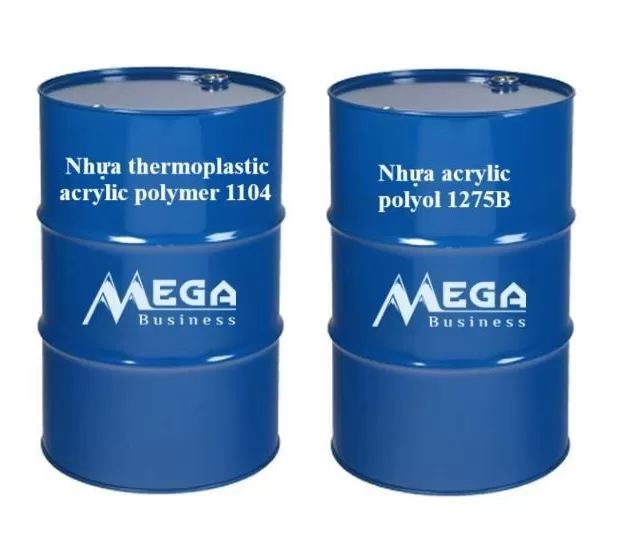
Two typical products that can be used to better visualize this group are Acrylic Polyol Resin ESB-1274B and Thermoplastic Acrylic Polymer Resin ESB-1104, which are in Mega Vietnam's paint resin portfolio. ESB-1274B is a polyol-based acrylic resin, suitable for PU paint systems and compatible with many isocyanates, while ESB-1104 is a thermoplastic acrylic resin, with good adhesion, mechanical strength and compatibility with many other solvent and resin systems.
WHAT IS AMERICAN PLASTIC?
In terms of application, it is understandable bisexual plastic is a name that emphasizes the ability of a plastic to participate or adapt to many different paint formulation systems, thanks to the appropriate polymer structure, functional groups and compatibility properties.
For acrylic resins, this versatility can come from many factors such as the type of monomer used, molecular weight, functional groups on the polymer chain, polarity, solubility and film formation mechanism. Therefore, both types of resin can be called “amphiphilic acrylic” but can still differ significantly in how they are used in paint formulations.
The important point is that “amphiphilic” is not always an independent polymer classification level. In coating techniques, acrylic resins are also classified according to chemical composition, functional groups, dispersion medium and especially film formation mechanism such as thermoplastic acrylic resin or thermosetting acrylic resin.
WHY IS ACRYLIC PLASTIC OFTEN USED IN INDUSTRIAL PAINT?
Acrylic resin is one of the important polymer groups in the coating industry thanks to its film-forming ability and the ability to adjust properties through the choice of monomer and functional groups.
Depending on the structure, acrylic resins can provide a balance between hardness, flexibility, adhesion, gloss, weather resistance, color fastness and chemical resistance. This is also the reason why acrylic resin is used in many different paint systems instead of just serving a single application.
In practice, the manufacturer can adjust the polymer formulation to favor one or several properties. For example, one type of resin may be designed to increase hardness and gloss, while another type places more emphasis on adhesion to the resin, flexibility, or the ability to work with curing agents.
ACRYLIC POLYOL PLASTIC ESB-1274B BIVALITY
Acrylic Polyol ESB-1274B resin in Mega Vietnam's catalog is a polyol-based acrylic resin, belongs to the group of amphoteric acrylic resins and is used mainly in high-end industrial paint systems.
The product stands out with properties such as high gloss, high hardness and high solid content, and is compatible with a variety of isocyanates. These are important characteristics when building PU paint systems, especially with formulas that require paint films with high hardness, gloss and aesthetics.
In essence, acrylic polyol is an acrylic resin containing hydroxyl groups on the polymer chain. In the 2K PU system, these hydroxyl groups can react with the isocyanate group of the curing agent to form a cross-linked polymer network. This mechanism helps improve the hardness, mechanical strength and environmental resistance of the paint film after curing.
ESB-1274B plastic is suitable for high quality PU paint and industrial paint. Compatibility with a variety of isocyanates gives manufacturers more options when designing paint systems. Depending on the type of isocyanate, mixing ratio and other ingredients, the paint film can be adjusted according to requirements for hardness, gloss, durability and surface protection.
This is a prime example of how an acrylic resin must be evaluated not only by the polymer itself but also by considering the entire coating system and curing mechanism.
THERMOPLASTIC ACRYLIC POLYMER ESB-1104
If ESB-1274B resin represents the acrylic polyol direction capable of participating in the reaction with isocyanate in the PU system, then ESB-1104 resin towards thermoplastic acrylic.
The product's trade name is Thermoplastic Acrylic Polymer 1104, originating in China and has advantages such as mechanical strength, adhesion, flexibility and compatibility with many other solvents and plastics.
ESB-1104 resin has good solubility in toluene, n-butyl acetate, acetone and xylene, and is compatible with aliphatic polyisocyanate, aromatic polyisocyanate, CAB and cellulose nitrate. These are characteristics that have practical significance when manufacturers develop paint formulas that need to combine many types of materials.
WHAT IS THE DIFFERENCE FROM THERMOPLASTIC ACRYLIC?
This is one of the most important points when learning about acrylic resin used in paint.
Thermoplastic acrylic resins mainly form films through solvent evaporation and physical bonding between polymer chains. After film formation, the polymer does not form an extensive chemical cross-link network like thermosetting systems. Therefore, this type of plastic often has advantages in drying speed, processing ability and coating repair ability.
Meanwhile, thermosetting acrylic resins often contain functional groups that can react with the curing agent or with another component to form a cross-linked polymer network. Once completely cured, the paint film usually has better hardness, solvent resistance, chemical resistance and heat resistance.
Therefore, “amphiphilic acrylic” should not be confused with “thermoplastic” or “thermosetting”. These are different classifications and need to be considered based on the technical information of each product.
ADVANTAGES OF AMERICAN ACRYLIC PLASTIC IN PAINT PRODUCTION
One of the notable advantages is the flexibility when formulating. Depending on the type of acrylic, the manufacturer may combine the resin with solvents, curing agents, pigments, additives or other polymers to achieve the desired properties.
1. Good adhesion
Adhesion is an important requirement for industrial paint, especially when coating metal, plastic or old paint.
ESB-1104 is introduced with good adhesion to metals and plastics, and can be used in repair coating applications.
2. Gloss and aesthetics
For paint systems that require beautiful surfaces, the gloss and film-forming ability of the plastic are very important factors.
ESB-1274B plastic has high gloss and hardness, large solid content and the ability to create beautiful, durable films.
3. Ability to coordinate with many components
A resin that has good compatibility with other resins or solvents leaves more room for the manufacturer to adjust the formulation.
For ESB-1104 resin, the product information states compatibility with many solvent systems and some polyisocyanates, CAB and cellulose nitrate.
4. Balance between stiffness and flexibility
A paint film that is too hard can crack easily when the substrate deforms, while a film that is too soft can reduce its resistance to scratches or mechanical impact.
This is why acrylic systems are designed with many different polymer structures to create a balance between stiffness, flexibility, adhesion and mechanical strength.
WHERE ARE BENEFITS PLASTIC APPLIED?
Amphoteric acrylic resins can appear in many groups of industrial paints, depending on the structure and characteristics of each product.
1. Metallic paint
Acrylic resins can be used as film formers for metal coating systems, where requirements typically include adhesion, hardness, gloss, abrasion resistance and environmental durability.
ESB-1104 is recommended for metal coating applications, where the resin contributes to a coating that is mechanically durable and maintains aesthetics.
2. Plastic paint
Plastic surfaces are often more difficult to paint than metals due to different surface energy, polarity, and interaction between the substrate and the film-forming agent.
Therefore, acrylics with good adhesion to plastic substrates are valuable in industrial plastic detail painting applications. ESB-1104 is introduced for this group of applications.
3. Car paint and repair paint
Acrylic is an important polymer group in the automotive paint industry thanks to its ability to create beautiful films, retain color and adjust many properties.
For PU systems, acrylic polyol can act as a base resin to react with polyisocyanate, creating a cross-linked paint film. Meanwhile, thermoplastic acrylic can be selected for formulations that prioritize drying speed, repairability or other film-forming requirements.
4. Industrial paint
This is one of the widest application groups of acrylic resins. Depending on the type of plastic, the product can be used in painting machinery, equipment, metal structures, components, maintenance paint and many other types of industrial coatings.
When choosing amphoteric acrylic resin for paint production, businesses should determine in advance the type of substrate to be coated, gloss and hardness requirements, curing mechanism, solvent system, curing agent and requirements for the final durability of the paint film. Choosing the right type of resin from the beginning will help make the paint formula more stable and significantly reduce testing and adjustment time.
>> See details Amphoteric plastic <<
>> See more Amphoteric plastic ESB-1274B <<
>> See more Amphoteric plastic ESB-1104 <<
>> See details LongOil Alkyd Resin QA-131-M80 <<
For further information, please contact:
Mega Vietnam Editorial Board
Address: Floor 2-A2-IA20, Nam Thang Long Urban Area, Pham Van Dong Street,
Dong Ngac Ward, Bac Tu Liem District, City. Hanoi, Vietnam.
Email: contact@megavietnam.vn
Tel: (+84) 24 375 89089; Fax: (+84) 24 375 89098
Website: megavietnam.vn
Hotline: 1800.577.728; Zalo: 0971.023.523