So why is the same formula but the paint surface quality is different between batches? The cause may lie in contamination, additive compatibility, dispersion conditions, air bubbles or construction parameters. Correctly identifying the error mechanism will help businesses choose the appropriate solution, limiting the need to adjust the formula in an uncontrolled way.
DISTINGUISHING THE PHENOMENON OF FISH-EYE AND NEEDLEHOLE IN PAINT FILM
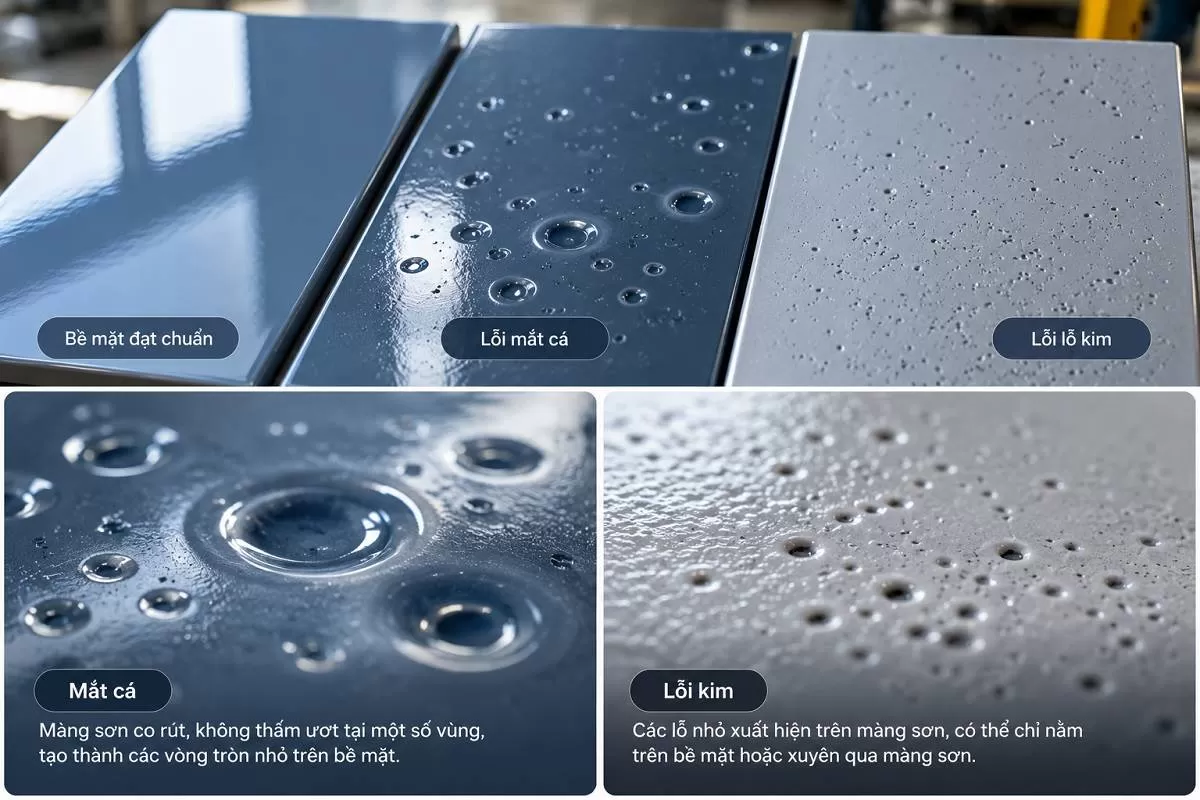
Fisheyes and pinholes are both common surface defects, but are not exactly the same in their formation mechanism.
**Fish eyes** are often shaped like small circles, where the paint layer has shrunk, cannot be spread evenly, or forms a concave area with the center distinct from the surrounding area. This phenomenon is often related to surface tension differences, contamination or incompatibility between components in the paint system.
**Pinholes** are small holes that appear on the paint film, which can be just on the surface or penetrate the paint film depending on the degree of defect. They are often related to solvent gases or vapors released as the paint film is forming, trapped air bubbles, excessive viscosity, or improper drying conditions.
The two phenomena can appear simultaneously. However, if the fish eye is treated by increasing the defoamer when the real cause is silicone or grease contamination, the improvement effect may be very low. On the contrary, if the pinholes are caused by gases trapped in the paint film, simply adding a leveling agent will not completely solve the problem.
WHY DOES PAINT HAVE FISH-EYE AND NEEDLE HOLE EVEN THOUGH THE FORMULAS HAVE NOT CHANGED?
1. Contamination from equipment, pipes and production environment
One of the causes that is often overlooked is contamination during the manufacturing process. Lubricants, grease, silicone, residual cleaning agents, dust or paint residue from a previous batch can enter the paint system even if the mixing ratio remains the same.
These substances can change the local surface tension, making it difficult for the paint to wet or spread evenly on the surface. At that time, the paint film can form shrinkage areas characteristic of the fisheye phenomenon.
Therefore, it is necessary to check the stirring tank, impeller, pipes, filter, sampler and substrate surface before adjusting the formula. With silicone-sensitive paint systems, the use of equipment with silicone-containing products should also be carefully evaluated.
2. Incompatible additives or quality changes between batches
Additives play an important role in controlling wetting, dispersing, defoaming and leveling the paint film. However, the effectiveness of additives depends on the chemical nature, type of base resin, solvent or water environment, as well as usage ratio and mixing sequence.
Even if the formula remains the same, changing the supplier, product code, batch of raw materials or additive storage conditions can change the properties of the paint system.
For example, a leveling agent that reduces surface tension too strongly or is incompatible with the base resin may cause defects instead of improving flatness. Similarly, defoamers that are not suitable for the paint system can leave surface defects or reduce clarity and gloss.
Therefore, when errors appear after importing a new batch of raw materials, businesses should compare batch records, specifications, storage conditions and test results before concluding that additives are the cause.
3. Air bubbles are trapped in the paint film
During mixing, pumping, filtering and application, air can be drawn into the paint. If air bubbles cannot escape before the paint film cures or dries the surface, they can form pinholes or pitting defects.
This risk increases when the stirring speed is too high, the stirrer design is inappropriate, the paint viscosity is high, or the air release time is insufficient. Some application methods such as spray painting can also increase the amount of air entrained in the system.
In this case, the solution needs to be selected based on the foaming mechanism and characteristics of the paint system. Defoamers can assist in reducing foam, but stirring speed, feed procedure, viscosity and rest time should be checked simultaneously before application.
4. The solvent or water released does not match the rate of film formation
When the paint film dries too quickly on the surface, it may be difficult for the solvent or water inside to escape. Trapped gases and vapors can create pinholes, especially in thick paint films or when ventilation, temperature and humidity conditions are inadequate.
For solvent paints, the solvent composition and evaporation rate need to be considered. For water-based paints, it is necessary to evaluate the water loss rate, environmental humidity, film-forming ability and drying conditions. It should not be assumed that all cases of pinholes are due to lack of defoaming agent.
In addition, applying the paint layer too thickly, drying at high temperatures or applying the product to the next stage too early can increase the risk of defects.
5. The viscosity and leveling ability of the paint changes
Viscosity affects the paint film's ability to spread evenly, air out and level. When the viscosity is too high, it is difficult for air bubbles to escape and the dents may not be filled. On the contrary, if the viscosity is too low or the rheological properties are not suitable, the paint film may sag or have difficulty maintaining a uniform thickness.
Actual viscosity may vary due to temperature, storage time, solvent evaporation, pH fluctuations in some water-based paint systems or interactions between components. Therefore, the fact that the formula does not change does not mean that the state of the paint system is always the same.
6. The material surface has not been cleaned or is difficult to wet
The paint film can only form evenly when the paint is well wetted on the substrate surface. Grease, dust, polish, mold release agent or other contaminants can cause paint to shrink in some areas.
This phenomenon is often encountered on metals, plastics and parts that have been mechanically processed or used mold release agents. Some plastics with low surface energy also make it difficult for paint to wet if not properly surface treated.
Before changing additives, it is necessary to confirm the condition of the substrate, the cleaning method and the compatibility between the paint and the material to be coated.
QUICK DIAGNOSIS TABLE FOR FISH-EYE AND NEEDLE HOLE ERRORS
|
Observation signs |
The cause needs to be checked |
Initial treatment direction |
|
The paint film shrinks into a circle with a concave center |
Contamination, surface tension difference, additive incompatibility |
Check equipment and substrate cleanliness; Additive compatibility test |
|
Small holes appear after the paint dries |
Air bubbles, solvent vapor or water cannot escape in time |
Check stirring procedure, film thickness and drying conditions |
|
The error appeared after changing the batch of additives |
Variation in quality or difference in material characteristics |
Batch record reconciliation and comparative testing |
|
Error increases with high speed stirring |
Air entrainment or foaming during mixing |
Adjust speed, filling sequence and air release time |
|
Errors are concentrated on one type of substrate material |
Contamination or poor wettability |
Check cleaning methods and surface treatments |
|
The error only appears when drying or applying under certain conditions |
Temperature, humidity, evaporation rate or film thickness |
Retest application and drying conditions |
The table above is intended to guide initial testing and is not a substitute for confirmatory testing. A signal can originate from many different mechanisms.
WHICH ADDITIVE SHOULD YOU CHOOSE TO LIMIT FISH-EYE AND NEEDLE HOLE?
There is no single additive that can treat all surface defects. The selection should be based on the identified cause, type of paint and quality requirements of the coating.
**Defoaming and degassing additives** are considered when the problem is primarily related to air bubbles or trapped air in the paint film. It is necessary to distinguish between the ability to prevent foaming, destroy formed foam and support gas release; These functions are not exactly the same.
**Wetting additives** can help paint reach and spread better on surfaces that are difficult to wet. However, it is necessary to check compatibility and influence on other features of the paint film.
**Leveling additive** aids in improving surface flatness, uniformity and morphology. The selection needs to be appropriate to the resin system, water or solvent environment, gloss and anti-defect requirements.
**Dispersant additives** play a role in stabilizing pigments and fillers in the paint system. While not a direct solution for every fisheye or pinhole problem, the right dispersant can contribute to maintaining the uniformity of the paint system.
When choosing, consider the type of base resin, solids content, viscosity, application method, drying conditions and compatibility between additives. Do not increase the dosage immediately before determining the cause, because excessive use or inappropriate combination can create new defects.
CHECK PROCEDURE WHEN ERRORS APPEAR EVEN THOUGH THE FORMULA IS THERE'S NO CHANGE
To reduce processing time and avoid unnecessary testing costs, businesses can deploy the testing process in the following order:
**Step 1: Confirm defect characteristics.** Record shape, size, density and time of fisheye or pinhole appearance. Distinguish errors that appear immediately when the paint is wet from errors that are only visible after drying.
**Step 2: Compare passing batches and failing batches.** Compare batch numbers of raw materials, additives, stirring time, stirring speed, temperature, viscosity, pH if appropriate for the paint system, as well as construction conditions.
**Step 3: Inspect equipment and substrate.** Clean equipment as necessary, check for grease or silicone contamination, and confirm material cleaning procedures.
**Step 4: Test each factor.** Perform a control experiment, changing only one factor in each test. Can start from stirring conditions, air release time, film thickness or suspected additive, depending on the actual indication.
**Step 5: Confirm on production conditions.** Once the improvement plan has been identified, it is necessary to re-evaluate the surface quality and important features such as adhesion, gloss, durability and stability during storage.
This approach helps avoid changing multiple components at the same time, leaving businesses unable to determine which factors are truly effective.
HOW TO LIMIT RECURRENCE OF ERRORS IN NEXT PAINTING MODELS?
In addition to choosing the right additives, the stability of the production process is of great significance. Businesses should control equipment cleaning, standardize material loading sequences, maintain proper stirring conditions, and monitor important parameters of each batch.
Saving control samples, recording batch numbers of raw materials and taking photos of the surface after drying also helps identify error trends earlier. When changing additive suppliers or batches, compatibility testing should be performed before large-scale application.
For paint systems with high requirements for gloss or surface quality, developing visual inspection criteria and standard sample evaluation procedures will help reduce differences between production batches.
Paint with fish eyes and pinholes even though the formula has not changed is not necessarily due to poor quality additives. Causes may stem from contamination, material fluctuations, air bubbles, wettability, viscosity or application and drying conditions.
To treat effectively, it is necessary to distinguish the correct type of defect, check each group of causes and conduct controlled testing before adjusting the formula. Only when the error mechanism is determined will businesses have a basis for choosing appropriate defoaming, wetting, leveling or dispersing additives.
MegaVietnam provides information and solutions for industrial materials serving the paint, plastic and rubber sectors. Businesses can refer to the list of paint additive products to choose a group of materials suitable for the paint system and actual application requirements.
Note: The choice of additives and usage rates should be based on the manufacturer's technical documents, compatibility tests and specific production conditions.
>> See more Additives for paint <<
>> See more Epoxy resin SM828 <<
>> See more Plastic for industrial paint <<
>> See more Epoxy curing <<
MEGA VIETNAM GENERAL TRADING COMPANY LIMITED
Address: Floor 2-A2-IA20, Nam Thang Long Urban Area, Ward. Pham Van Dong, Phu Thuong Ward, City. Hanoi.
E-mail: contact@megavietnam.vn; Tel: (+84) 24 375 89089;
Website: megavietnam.vn; Hotline: 1800.577.728; Zalo: 0971.023.523