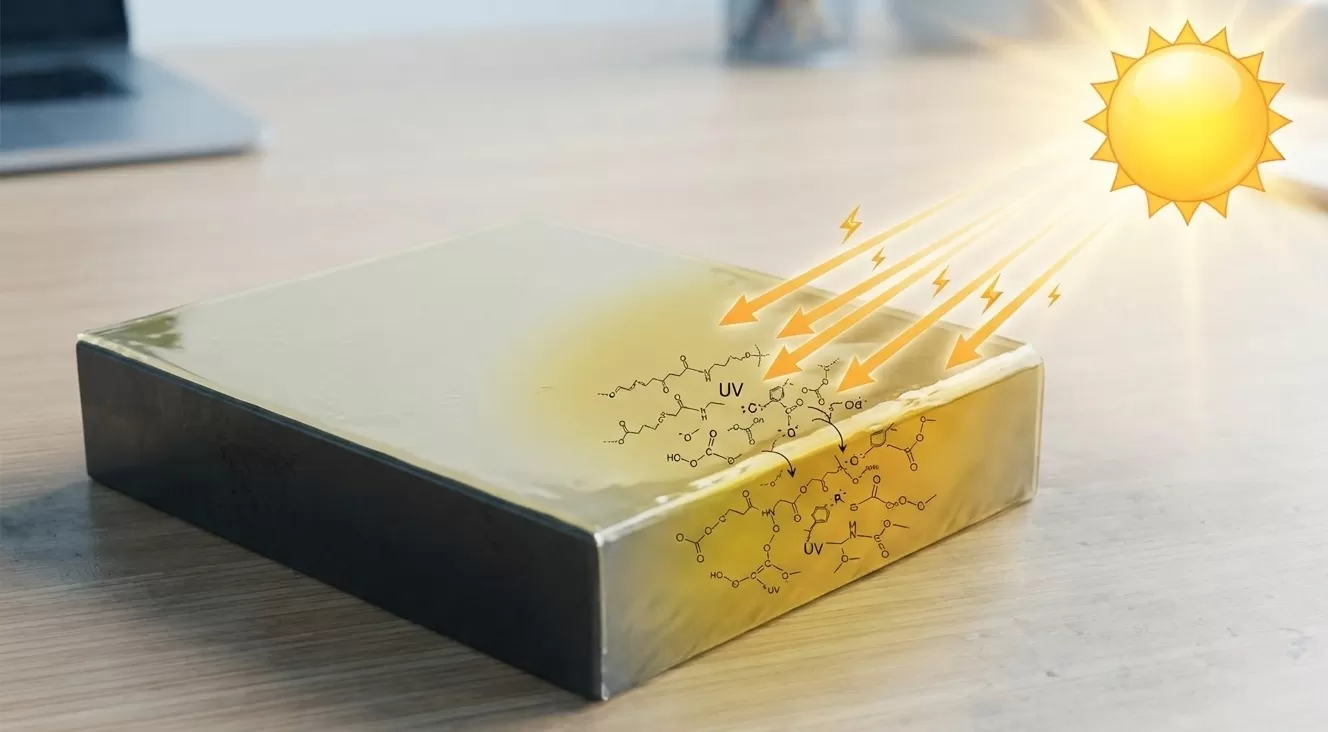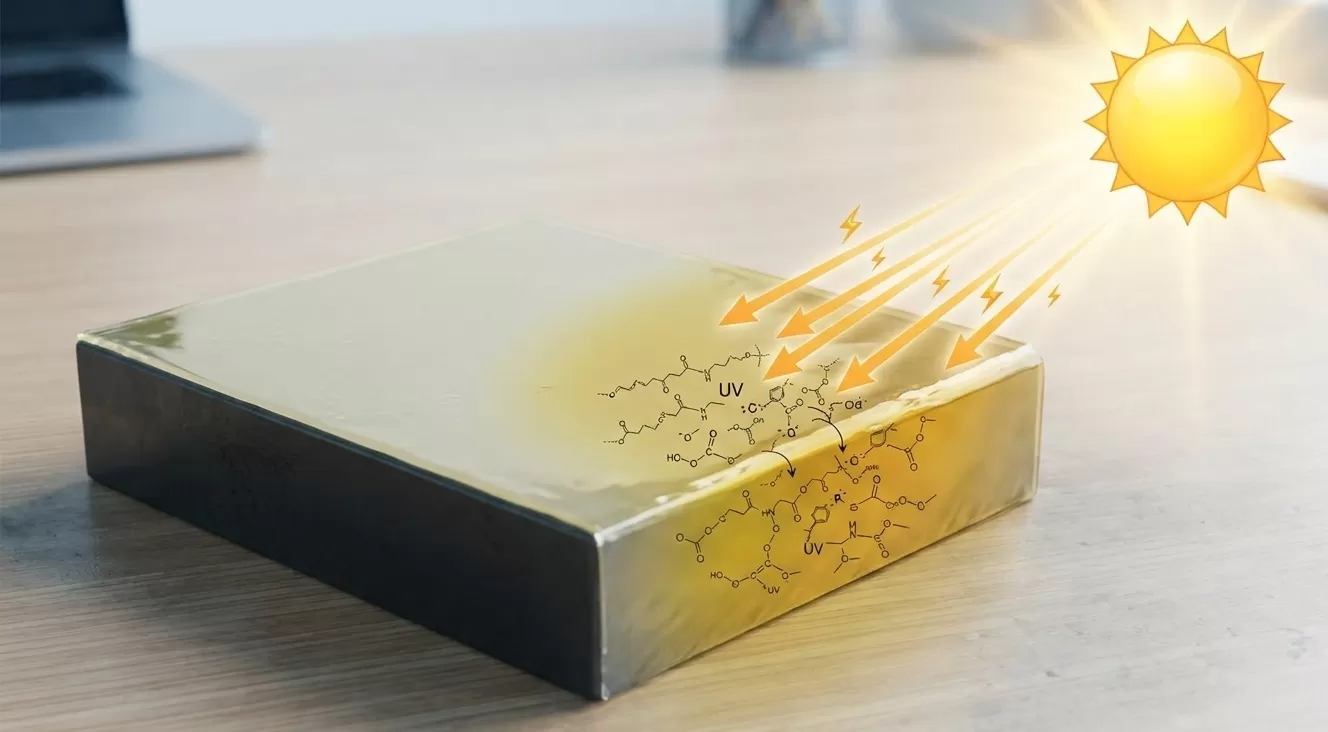
This phenomenon is not simply an external color change but a sign of aging and photo-oxidation in the polymer structure. UV radiation can trigger free radical reactions, which then react with oxygen in the air and form chemical groups that absorb visible light, causing the epoxy to gradually change from transparent to yellow, yellow-brown or dark.
HOW DOES SUNSHINE AFFECT EPOXY PLASTIC?
Sunlight contains many different radiation components, of which ultraviolet (UV) rays have enough energy to cause chemical changes in many polymers. When epoxy is exposed to UV for a long time, the radiant energy can stimulate chemical bonds in the polymer network, creating free radicals and highly reactive intermediate products.
In the presence of oxygen, free radicals continue to participate in photo-oxidation reactions (photo-oxidation). This process can alter the polymer structure, creating carbonyl groups, double bonds and conjugated structures. These are chromophores - chromophores, capable of absorbing part of visible light and making the material appear yellow.
WHY DOES CLEAR EPOXY TURN YELLOW?
For transparent epoxy, users can easily notice the color change because the original material background is almost colorless. As oxidation products and light-absorbing structures form during aging, the light transmitted through the material is altered and the human eye perceives a yellowing or yellow-brown appearance.
Research on the UV aging process of epoxy shows that the color of the material can gradually change from light yellow to dark yellow as the UV irradiation time increases. The change primarily appears in the surface layer directly exposed to radiation, and can then grow deeper into the material as the aging process continues.
OXYGEN IN THE AIR MAKES THE YELLOWING PROCESS MORE SERIOUS
An important point is that UV is not the only factor that causes yellowing. The process is often closely related to the presence of oxygen. UV radiation creates free radicals in epoxy, then oxygen in the environment participates in the oxidation reaction chain and creates new products in the polymer network.
Studies on the mechanism of epoxy yellowing show that this process can create chromophores such as carbonyl groups, double bonds and conjugated structures. Therefore, the yellowing phenomenon of outdoor epoxy is essentially a photo-oxidation process, not simply "UV rays change the color of plastic".
This also explains why limiting exposure to oxygen or preventing UV light from reaching the surface can slow down the aging process. However, in actual outdoor use conditions, completely removing oxygen is almost impossible, so effective solutions often focus on reducing UV and improving the stability of the epoxy system.
EPOXY RESIN COMPOSITION AND CURING AGENT ALSO AFFECT THE POSSIBILITY OF YELLOWING
Not all epoxy systems have the same degree of yellowing. Yellowing resistance depends on the chemical structure of the base resin, curing agent, accelerator, additives and other ingredients in the formulation. Some chemical structures have the ability to absorb UV or easily participate in oxidation reactions, which will make the epoxy system more sensitive to the aging process.
In particular, studies on epoxy–amines show that photodegradation can involve both the epoxy portion and the amine bonds in the cured network. A mechanistic study documented the formation of oxidation products of the DGEBA moiety and the amine bond, of which some structures such as quinone methide were associated with yellowing upon irradiation.
HIGH TEMPERATURES MAY CAUSE EPOXY TO YELLOW FASTER
Epoxy placed outdoors is not only subject to UV but is also often subject to high temperatures due to absorption of solar radiation. High temperatures can accelerate oxidation reactions and aging of polymers, causing color changes to occur more rapidly.
Notably, epoxy can still yellow even without direct exposure to UV if subjected to long-term heat and humidity conditions. A study on the epoxy–amine system showed that the thermo-oxidation process can create carbonyl groups in the polymer structure and this is one of the causes of irreversible yellowing.
MOISTURE CAN ALSO CONTRIBUTE TO THE AGING PROCESS
In outdoor environments, epoxy is often simultaneously affected by UV, heat, oxygen, humidity, rain and wet-dry cycles. Therefore, the actual aging phenomenon is often more complicated than the UV-only test.
Research on epoxy and vinyl ester yellowing shows that natural conditions can complicate the yellowing process due to the influence of humidity and wet-dry cycles. Therefore, if an epoxy product is used outdoors, simply evaluating UV resistance is not enough; It is necessary to consider the weathering resistance of the entire material system.
DOES EPOXY YELLOWING MEAN THAT THE MATERIAL HAS COMPLETELY LOST DURABILITY?
Not necessarily. Yellowing is often one of the first visible signs of surface aging. However, if UV exposure continues for long periods of time, the decomposition can go further and cause loss of gloss, microcracking, changes in mechanical properties or the formation of a degraded surface layer.
Studies on UV-resistant epoxy show that the initial degradation process is strongly concentrated in the surface layer directly exposed to radiation. With prolonged aging, the surface may show more pronounced changes, including discoloration, microcracking, and structural deterioration.
CAN EPOXY BE COMPLETELY YELLOWD?
In reality, it is very difficult to ensure that transparent epoxy does not turn yellow if exposed to the sun for a long time. A more realistic goal is to slow down the yellowing process and prolong the original color retention time.
The most effective solution is to limit the amount of UV exposure to the epoxy. For products that require high transparency but must be used outdoors, it is possible to combine the selection of an epoxy system with good UV resistance, use a suitable stabilizer and create an outer protective coating capable of blocking UV.
CHOOSE AN EPOXY TYPE WITH BETTER UV RESISTANCE
If the product must be exposed to sunlight regularly, from the beginning you should choose an epoxy designed by the manufacturer for outdoor applications or with UV protection requirements instead of using regular transparent epoxy.
This is especially important for applications such as resin tables, decorative materials, coatings, signs, composites and transparent products. Do not rely solely on the advertising “transparent epoxy” to evaluate anti-yellowing ability; Need to see technical specifications or test data on UV resistance, weathering or yellowing resistance of the product.
USE UV ABSORBENT AND LIGHT STABILIZER
One approach in polymer formulation is to use UV absorbers and light stabilizers to reduce the impact of UV radiation on the material. UV absorber is responsible for absorbing part of UV energy before this energy causes photochemical reactions in the polymer.
However, the effectiveness of the additive depends greatly on the type of epoxy, concentration used, material layer thickness and environmental conditions. Notably, an experimental study of epoxy and vinyl ester showed that UV absorbers and antioxidants alone did not always provide the expected anti-yellowing effect under test conditions; Therefore, the addition of a single additive should not be considered an absolute solution.
COAT AN ANTI-UV PROTECTIVE LAYER ON THE EPOXY SURFACE
For finished epoxy products, a practical solution is to use a protective UV-resistant coating on the outside. This coating acts as a barrier, limiting UV radiation from directly reaching the epoxy layer below.
In applications where long-term color and gloss retention are required, a coating system specifically designed for outdoor environments may be considered. This approach is especially useful when the underlying epoxy layer itself is not highly UV resistant but still needs to maintain transparency or an aesthetic effect.
LIMIT DIRECT SUN WHEN POSSIBLE
This is a simple but often overlooked solution. If epoxy products are not required to be placed outdoors, locating them out of direct sunlight, using awnings, glass or UV reduction solutions can significantly reduce exposure.
For indoor decorative products, avoiding placing them near windows with direct sunlight for long periods of time also helps reduce the rate of aging. It should be noted that conventional glasses do not always eliminate all UV, so the protective effect depends on the type of glass and the specific UV filtering ability.
CONTROL TEMPERATURE AND ENVIRONMENTAL CONDITIONS
In addition to UV reduction, temperature control is also significant in extending epoxy life. Dark surfaces or products exposed to direct sunlight can heat up significantly, increasing the rate of thermal-oxidative aging reactions.
In outdoor environments, a combination of UV reduction + heat reduction + water and moisture restriction is often more reasonable than focusing on just one factor. This is also a practical approach because the epoxy aging process is influenced simultaneously by many factors.
SOLUTION TO PREVENT YELLOWING FOR EPOXY RESIN
The epoxy yellowing control plan can be summarized by prioritizing from materials to surface protection. First, you should choose an epoxy system and curing agent with good color stability; Next, you can use a UV stabilizer additive system suitable for the formula. For outdoor products, a UV protective coating should be added instead of exposing the epoxy to direct sunlight.
For products requiring long-term transparency and color stability, actual UV/weathering test data of the material system should be checked before mass production. This is a more reliable way than just relying on the name "UV-resistant epoxy", because the level of color stability depends on the entire formula and conditions of use.
Epoxy resin susceptible to yellowing when exposed to sunlight for a long time mainly due to photo-oxidation, in which UV rays activate free radical reactions, then oxygen participates in the oxidation process and forms chromophores capable of absorbing visible light. Temperature, humidity, resin structure, curing agents and additives can also speed up or slow down the process.
To limit yellowing of epoxy, many measures should be combined: choose an epoxy system with good UV stability, use appropriate stabilizers, apply an anti-UV protective layer and limit direct sunlight when usage conditions allow. For outdoor applications or high color fastness requirements, evaluation by actual UV and weather aging testing will help select a more suitable formulation and coating system.
>> View category details Epoxy resin <<
>> See more epoxy resin SM828 <<
>> See more Epoxy resin YD 011X75 <<
>> See more Longoil alkyd resin <<
MEGA VIETNAM GENERAL TRADING COMPANY LIMITED
Address: Floor 2-A2-IA20, Nam Thang Long Urban Area, Ward. Pham Van Dong, Phu Thuong Ward, City. Hanoi.
Email: contact@megavietnam.vn; Tel: (+84) 24 375 89089;
Website: megavietnam.vn; Hotline: 1800.577.728; Zalo: 0971.023.523