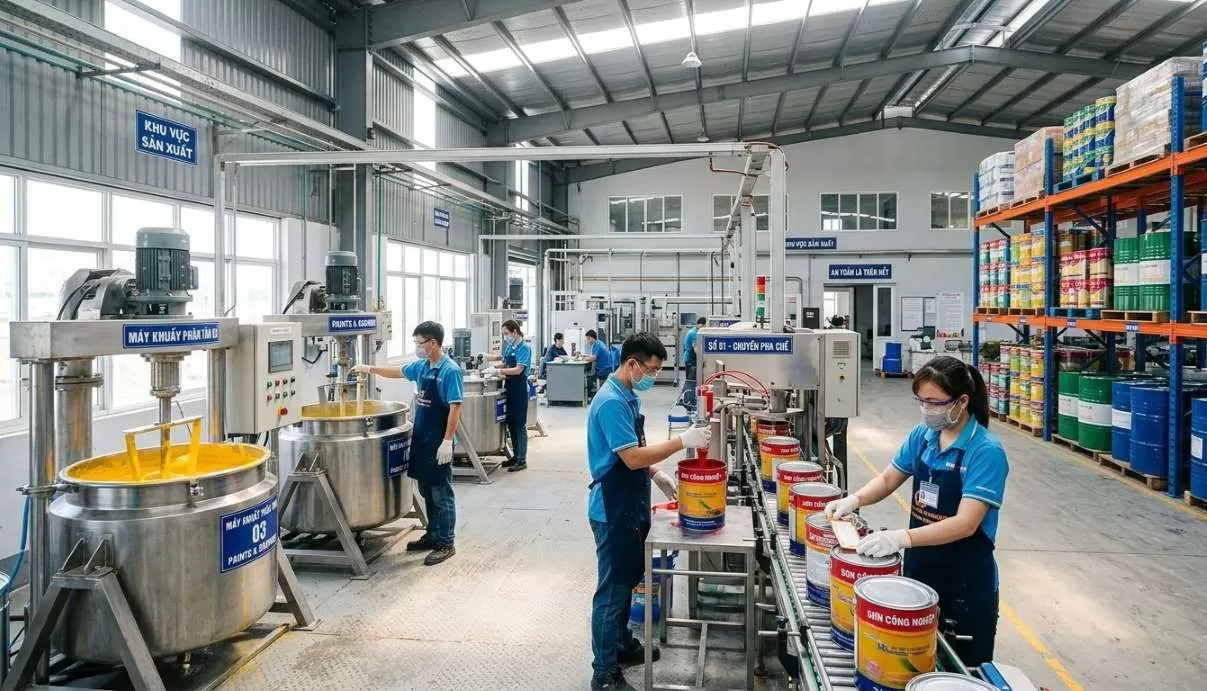
HOW MUCH CAPITAL IS NEEDED TO OPEN A PAINT PRODUCTION FACTORY?
There is no fixed capital level for all paint factories. The cost depends greatly on the type of paint, capacity, factory area, level of automation and whether the business rents or owns the premises. A small workshop specializing in the production of water-based paints can start with a significantly lower investment than a factory producing industrial paints, solvent paints or large capacity lines.
If only considering an estimate for initial investment planning, a small-scale facility may need about 1–3 billion VND, while a medium-sized factory model with equipment system, raw material warehouse, testing room and complete infrastructure may need about 3–10 billion VND or more. This is a reference estimate, not a legally required capital level; Actual costs need to be calculated according to specific capacity and line configuration.
BIG COSTS WHEN OPEN A PAINT PRODUCTION FACTORY
Paint factory investment costs can often be divided into main groups including premises and factory, production machinery, auxiliary systems, environment and safety, testing laboratory, starting materials, packaging, legal procedures and working capital. In particular, machinery and raw materials are often the two groups that most directly affect production capacity, while factories, environment and safety significantly determine the ability to put the facility into legal operation.
COST OF RENTAL OR CONSTRUCTION OF A FACTORY
Premises are the first costs to consider. If a business rents an existing factory in an industrial park or industrial cluster, the initial capital can be significantly reduced compared to buying land and building the entire factory itself. However, a paint factory should not be evaluated solely based on its area, but should consider the ability to arrange production areas, raw material warehouses, finished product warehouses, chemical areas, testing rooms, packaging areas and waste treatment systems.
For small factories, businesses can consider an area of a few hundred square meters, while medium-sized facilities may need about 1,000 m² or more depending on capacity and warehouse organization. If you choose to rent a factory, you need to check from the beginning to see if the location is suitable for the expected production line, instead of renting the premises first and then handling environmental, fire protection and chemical requirements.
COSTS OF RENOVATION AND COMPLETION OF THE FACTORY
A normal factory may not immediately meet the requirements of paint production. Enterprises may have to invest in additional load-bearing foundations, chemical spill prevention areas, appropriate drainage systems, ventilation, lighting, electrical systems, material storage areas and safety solutions.
For workshops that use flammable materials or organic solvents, design and safety requirements will be significantly higher than workshops that only produce water-based paints. Therefore, choosing the type of paint right from the project planning stage has a direct impact on the cost of construction and auxiliary systems.
COST OF PAINT PRODUCTION MACHINERY
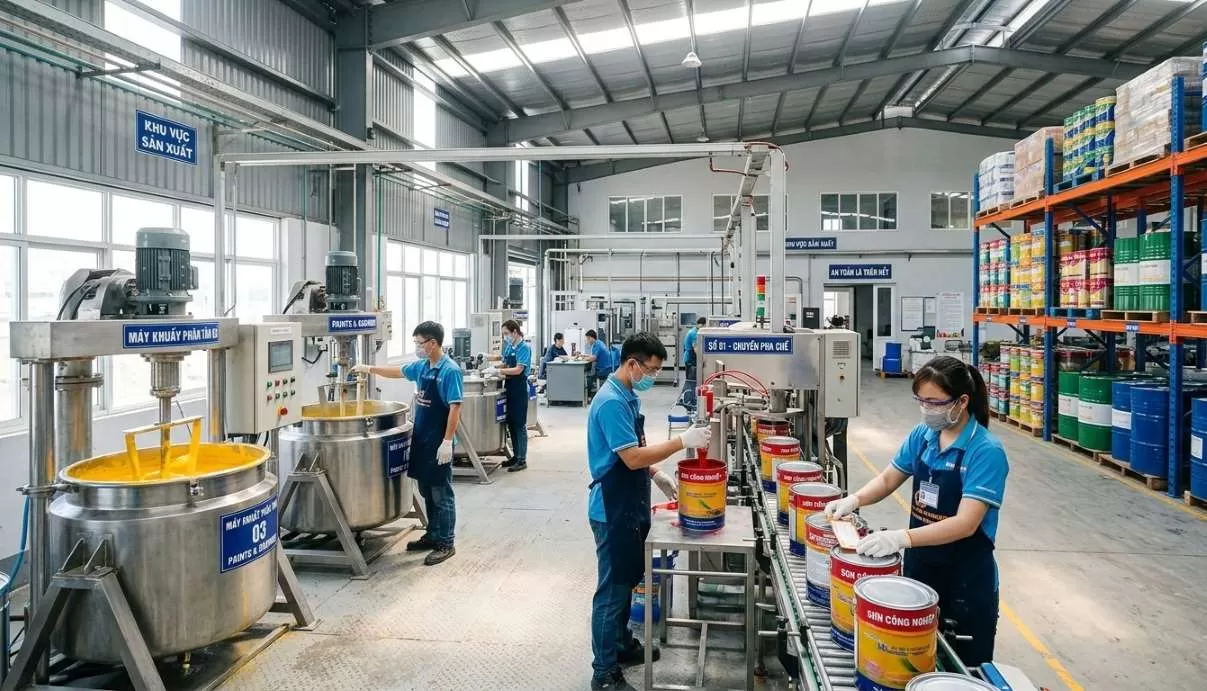
Machinery is one of the most important investments. A typical paint production line may include tanks, agitators, high-speed dispersers, mills or grinding equipment suitable for the formulation, filtration systems, finishing tanks, filling machines and capping and packaging equipment.
For small factories, businesses can prioritize semi-automatic lines to reduce initial investment capital. As production increases, equipment can be upgraded in stages. For large factories, using a higher automation system will help control dosage, stirring speed, temperature and mixing process better but at the same time significantly increase investment capital.
COST OF MATERIALS FOR PAINT PRODUCTION
Raw materials are a particularly important expense because not only do they need to be purchased for one batch of production, but businesses also have to maintain inventory to ensure continuous operation of the line. Depending on the type of paint, the formulation may use resins, film formers, pigments, fillers, solvents or water, dispersants, antifoam agents, viscosity modifiers and many other additives.
For water-based paints, businesses can use materials such as polymer emulsions, TiO₂, CaCO₃, silica, dispersants, antifoam agents and rheology modifiers. Meanwhile, solvent paints may require alkyd, acrylic, epoxy or polyurethane resins and suitable organic solvents.
Therefore, initial raw material capital can fluctuate greatly. A small factory can start with raw materials of a few hundred million VND, while a large capacity factory needs billions of VND in working capital just to maintain inventory of raw materials and finished products.
COST OF TESTING AND QUALITY CONTROL DEPARTMENT
A professional paint shop should not only focus on the mixer and ignore the testing room. Paint quality depends on many parameters such as viscosity, smoothness, density, color, coverage, drying time, adhesion and other physical and mechanical properties depending on the product.
Basic testing laboratories may need technical scales, analytical balances, viscosity measuring equipment, fineness meters, pH meters, hydrometers and paint film testing instruments. With high-end products or industrial paints, the testing equipment portfolio can expand significantly.
Investing in quality control not only helps detect defective products but also helps businesses maintain stable formulas between production batches, which is very important when building a paint brand in the market.
ENVIRONMENTAL COSTS AND WASTE TREATMENT
This is an expense that should not be overlooked when making an estimate. Paint production can generate wastewater, solid waste, chemical packaging, dust, and in some lines, solvent vapors or emissions that need to be controlled.
Specific requirements depend on the scale, technology, type of raw materials and level of environmental impact of the project. Decree 08/2022/ND-CP is one of the documents detailing the Law on Environmental Protection and is still partially in effect, so businesses need to determine the correct environmental procedures applied to the project instead of using a fixed cost for every workshop.
Environmental costs may include documentation consulting, treatment works, waste collection and treatment systems, monitoring and related investments. For a large-scale factory, this can be one of the most significant investments beyond the production line.
COSTS OF FIRE PREVENTION AND CHEMICAL SAFETY
Fire prevention and chemical safety are especially important for paint factories, especially when using flammable solvents. Costs may include fire alarm systems, fire suppression systems, pumps, pipes, fire extinguishers, suitable storage, electrical equipment and other technical solutions depending on the design.
Besides fire prevention, businesses must also pay attention to chemical safety. The Chemicals Law 2025 regulates chemical management along the entire life cycle and classifies chemicals into different management groups, including chemicals requiring special control and conditional chemicals.
This means that businesses need to review each ingredient in the paint formula to determine the corresponding legal obligations, instead of just considering the final paint product.
LEGAL COSTS WHEN OPEN A PAINT PRODUCTION FACTORY
Legal costs do not only include business registration. Depending on the model and materials used, businesses may have to carry out procedures related to investment, construction, environment, fire protection, chemicals, labor and safety.
In particular, the Law on Chemicals No. 69/2025/QH15 has taken effect from January 1, 2026. The law regulates chemical production activities including preparation, processing, extraction and related activities; At the same time, it sets requirements for legal documents, safety documents, physical and technical facilities and professional capacity for chemical activities within the scope of regulation.
Therefore, before investing in machinery, businesses should accurately determine the list of raw materials and production technology to know what legal requirements apply to the workshop.
PACKAGING AND PACKAGING COSTS
Packaging is often underestimated when it comes to capital planning. A commercial paint product needs a barrel, can or plastic bucket suitable for each capacity, along with lids, labels, seal films and other packaging supplies.
If a business provides many specifications such as 1 kg, 5 kg, 18 kg or 20 kg, the number of packaging codes will increase and lead to larger inventory capital. With a new brand, the number of specifications should be limited in the early stages to reduce capital pressure.
WORKING CAPITAL IS AS IMPORTANT AS MACHINERY COSTS
A common mistake when calculating the cost of opening a factory is to only calculate construction and equipment purchases. In fact, businesses still need capital to buy raw materials, pay salaries, electricity and water, transportation, packaging, maintenance and maintain operations while the product does not generate stable cash flow.
If the total investment in machinery and factories is 3 billion VND but the business only has a few hundred million VND left to buy raw materials and operate, the factory may still encounter difficulties immediately after going into operation. Therefore, it is advisable to set aside a separate amount of working capital instead of using all capital for fixed assets.
ESTIMATE CAPITAL STRUCTURE FOR A SMALL SCALE PAINT FACTORY
For a small factory model, businesses can refer to the capital structure in the direction of: 20–30% for factories and site improvements, 25–35% for machinery, 5–10% for testing laboratories and auxiliary equipment, 5–15% for fire protection and environment, 10–20% for original materials and packaging, the rest for records, personnel and working capital.
This is only a reference rate for planning. For example, if the total expected capital is 3 billion VND, it should not be understood that every 3 billion VND workshop must be allocated exactly according to the above ratio. A factory that rents available space will have a very different capital structure than a self-built factory; A water-based paint workshop is also significantly different from a solvent paint workshop.
WATER-BASED PAINT AND SOLVENT PAINTING: WHICH TYPE REQUIRES LOWER CAPITAL?
If the goal is to reduce the initial investment, water-based paints are often more accessible than solvent paints in many respects, especially when considering flammable solvent requirements and safety systems. However, this does not mean that every water paint workshop has low costs. Production scale, quality requirements, level of automation and environmental systems can still cause total investment capital to increase.
Solvent paint or specific industrial paint lines often require businesses to pay more attention to ventilation, explosion protection, chemical storage, appropriate electrical equipment and solvent vapor control. Therefore, when planning a project, determining what type of paint to produce should be done before choosing factories and equipment.
SHOULD I BUY MACHINERY IN THE FIRST PLACE?
For new businesses entering the market, it is not necessary to invest in highly automated lines from the beginning. One option to consider is to use a semi-automatic line with a capacity appropriate to the expected output, then upgrade each part as sales increase.
It is important to design the line from the outset to be scalable. Tanks, pipes, electrical systems, storage areas and premises should be calculated so that equipment can be added in the future without having to renovate the entire factory.
FACTORS THAT CAUSE THE COST OF OPENING A FACTORY TO INCREASE STRONGLY
There are many factors that can cause investment capital to exceed initial estimates. Notably, buying land instead of renting a factory, building a completely new factory, choosing highly automated lines, producing solvent paint, using many types of chemicals that need to be controlled, requiring specialized testing laboratories, large capacity and building a separate environmental treatment system.
In addition, if a business wants to produce many paint lines at the same time such as interior paint, exterior paint, waterproof paint, industrial paint, epoxy paint and specialized paint, the amount of raw materials, equipment and quality control requirements will also increase.
IS IT POSSIBLE TO OPEN A PAINTING FACTORY WITH A CAPITAL OF 500 MILLION VND?
In practical terms, 500 million VND is a very limited capital if the goal is to build a complete and independent paint factory. With this amount of capital, businesses may be more suitable for testing, outsourcing, formula development or product sales models instead of investing in a full factory right away.
If you want to build your own brand but don't have enough capital for a factory, another strategy is to outsource products to a facility that already has a suitable production line. When the market and sales are stable, businesses can continue to invest in their own factories. This method helps reduce initial capital pressure and limit the risk of investing in fixed assets too early.
WHAT DOES YOU NEED TO PREPARATION TO OPEN A PAINTING PRODUCTION FACTORY BEFORE BUYING A MACHINE?
Before ordering machinery, businesses should determine at least six factors including paint type, expected capacity, product formula, raw material list, factory location and applicable legal requirements. After having this information, you can choose the appropriate tank capacity, disperser capacity, grinding equipment, filling system and storage.
In particular, you should not buy a machine according to the advertised maximum capacity if the actual output is unknown. A line that is too large will increase investment capital and operating costs but will not generate additional revenue if the factory does not have enough orders.
The cost of opening a paint factory in Vietnam can range from about 1–3 billion VND for small models to billions or tens of billions of VND for large-scale factories, depending on the type of paint, capacity, premises, level of automation and environmental, fire protection and chemical requirements. These are guidance estimates, not legal capital levels or fixed quotes.
For businesses just starting out, a safe plan is usually to determine the market and type of paint first, choose a sufficient production scale, rent a suitable factory if necessary, invest in an expandable line and spend a significant portion of capital on raw materials as well as working capital. Especially in the context of the Chemical Law 2025 taking effect from January 1, 2026, checking the list of chemicals, safety requirements and legal obligations should be done right from the project planning stage.
Therefore, instead of asking the simple question "how much does it cost to open a paint factory", businesses should build estimates based on specific capacity, such as 100 tons/month, 300 tons/month or 1,000 tons/month. Once the capacity and type of paint have been determined, the costs of machinery, raw materials, factories and working capital can be calculated more realistically.
>> See more types Paint industry chemicals at Mega Vietnam <<
>> See more Epoxy resin <<
>> See more Epoxy resin SM828 <<
>> See more Zinc stearate (wood paint additive) <<
MEGA VIETNAM GENERAL TRADING COMPANY LIMITED
Address: Floor 2-A2-IA20, Nam Thang Long Urban Area, Ward. Pham Van Dong, Phu Thuong Ward, City. Hanoi.
Email: contact@megavietnam.vn; Tel: (+84) 24 375 89089;
Website: megavietnam.vn; Hotline: 1800.577.728; Zalo: 0971.023.523