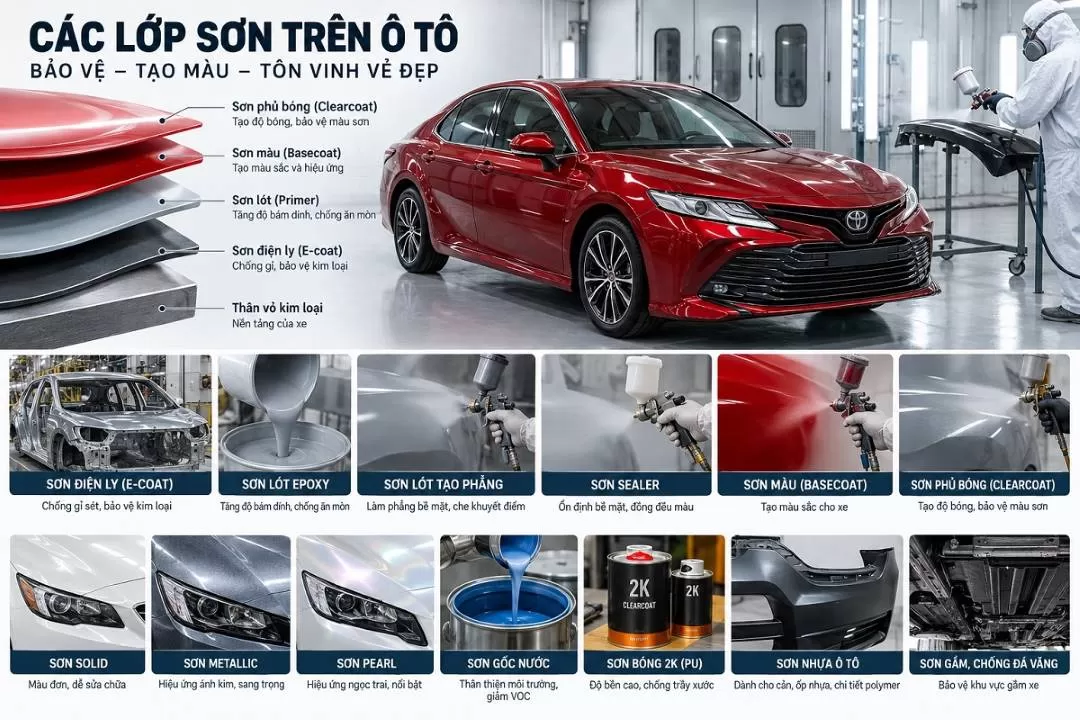
During the process of manufacturing, repairing or repainting a vehicle, choosing the right type of specialized automotive paint has a direct impact on the adhesion, color, gloss, corrosion resistance and durability of the coating. Below are the most popular paint lines today and the role of each type in the automotive paint system.
ANTI-RUST ELECTROPOINTING PAINT – THE FIRST LAYER OF PROTECTION FOR THE CAR BODY
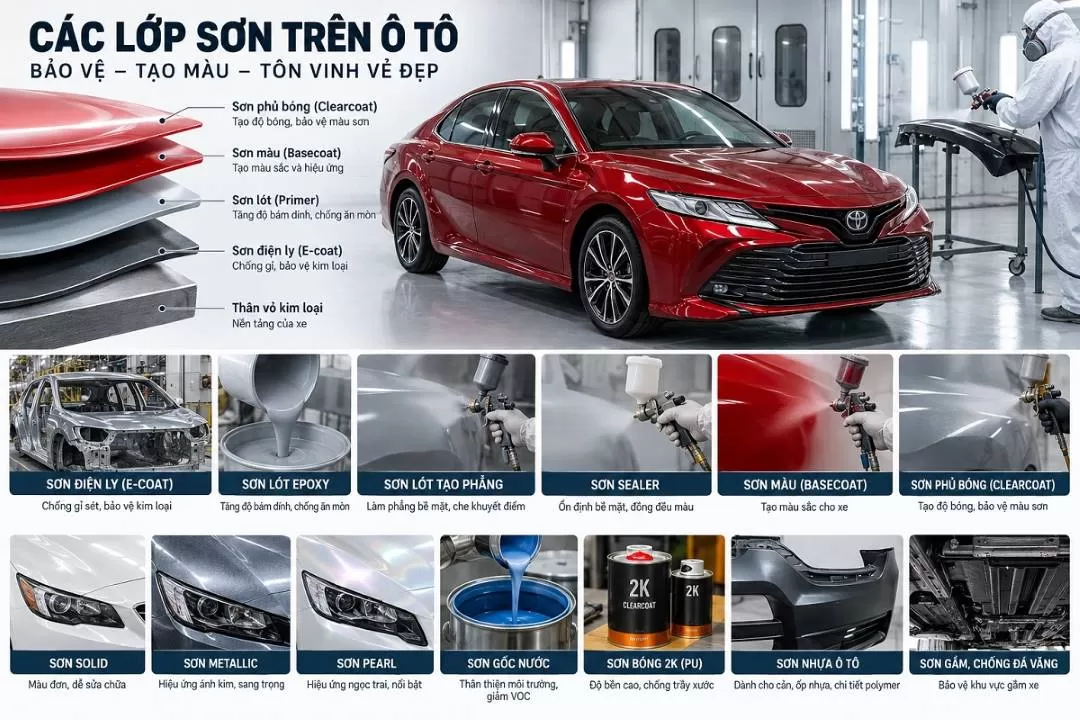
Electrolytic paint (Electrocoat or E-coat/ED) is often used in the automotive industrial painting process, especially in the metal body processing stage. Vehicle body parts are dipped in a paint bath and use an electrochemical process to create a relatively uniform coating on the surface, including hard-to-reach areas.
The main role of the electrolytic paint layer is to create an anti-oxidation and corrosion barrier for the metal. This is one of the important base layers that helps improve the durability of the paint system before continuing to apply the primer and color paint layers above.
EPOXY PRIMER FOR CARS
Epoxy Primer is a paint line commonly used when it is necessary to create good adhesion and protect metal surfaces from corrosion. Epoxy systems usually include epoxy resin and curing agent, after reacting to form a paint film with relatively high adhesion and protection.
In auto repair, epoxy primer is especially useful on metal surfaces that have been cleaned or treated after removing old paint. However, epoxy primer should not be considered a final finish for surfaces exposed to long-term direct sunlight; Normally, it is necessary to continue applying suitable paint layers on top to protect the paint system.
PRIMER SURFACER
After treating the metal surface, primer surfacer or filler primer is used to create a flat background and cover small defects before applying color. This type of paint is especially important in the repair painting process because the flatter and more uniform the surface is, the easier it is for the color and gloss layer above to achieve high quality.
Primer surfacer usually has the ability to create a relatively thick film and can be sanded after drying. Thanks to that, the painter can continue to treat small scratches, tiny holes or uneven spots before moving on to the painting stage.
SEALER PAINT – SURFACE STABILIZED INTERMEDIATE LAYER
Sealer paint has the function of creating an intermediate layer between the base and the finished paint layer. In some repair processes, sealers help isolate or homogenize the substrate, improving adhesion and limiting differences in paint absorption between areas.
This type of paint is especially useful when the repair surface has many different materials or substrates. When using the correct product system and according to the manufacturer's instructions, the sealer helps the basecoat layer above to become more uniform and stable in color.
AUTOMOTIVE PAINTING – BASECOAT
Basecoat, or car paint, is the layer that determines the color and visual effect of the vehicle. This is the layer where the user sees the most clear colors, such as white, black, red, blue or colors with special effects.
Automotive color paint can be developed in many different systems, of which the most common are solvent-based paints, water-based paints, solid, metallic and pearl paints. With modern basecoat/clearcoat systems, the basecoat layer mainly creates color and effects, then is protected by a transparent clearcoat layer outside.
SOLID COLOR AUTOMOTIVE PAINT – SINGLE COLOR
Solid paint is a color paint that does not create a clear metallic or pearl effect. Monochromatic white, black, red or blue colors are familiar examples of this group.
The advantage of solid paint is that the formula is relatively simple, the color is easily recognizable and is often easier to repair or repaint. However, compared to effect paint systems, solid surfaces often create a simpler feeling and the finishing quality depends a lot on the clearcoat layer as well as the construction technique.
METALLIC AUTOMOTIVE PAINT – METALLIC PAINT
Metallic paint contains effect particles, usually very small metal particles, that help the surface reflect light and create a sparkling feeling when viewed under different lighting angles.
This is one of the most popular paint styles on modern cars because of its ability to create depth and a more premium look than solid colors. However, the process of tinting and painting metallic requires better techniques because the distribution direction of the effect particles can affect the color perception after finishing.
PEARL AUTOMOTIVE PAINT – PEARL PAINT
Pearl paint uses special effect particles to create changes in light, depth and color nuance when viewed from different angles. Compared to regular solid colors, pearl paint has the ability to create a more prominent and premium feeling.
Due to the more complex color structure, color mixing and touch-up for pearl colors often require good control of mixing ratio, number of spray layers, paint film thickness and construction conditions. This is also one of the reasons why painting effect colors requires more advanced techniques than monochrome colors.
AUTOMOTIVE CLEAR COATING – CLEARCOAT
Clearcoat is a transparent paint layer applied over the color layer in a basecoat/clearcoat system. This layer plays a very important role in creating shine, protecting paint color and increasing resistance to environmental impacts.
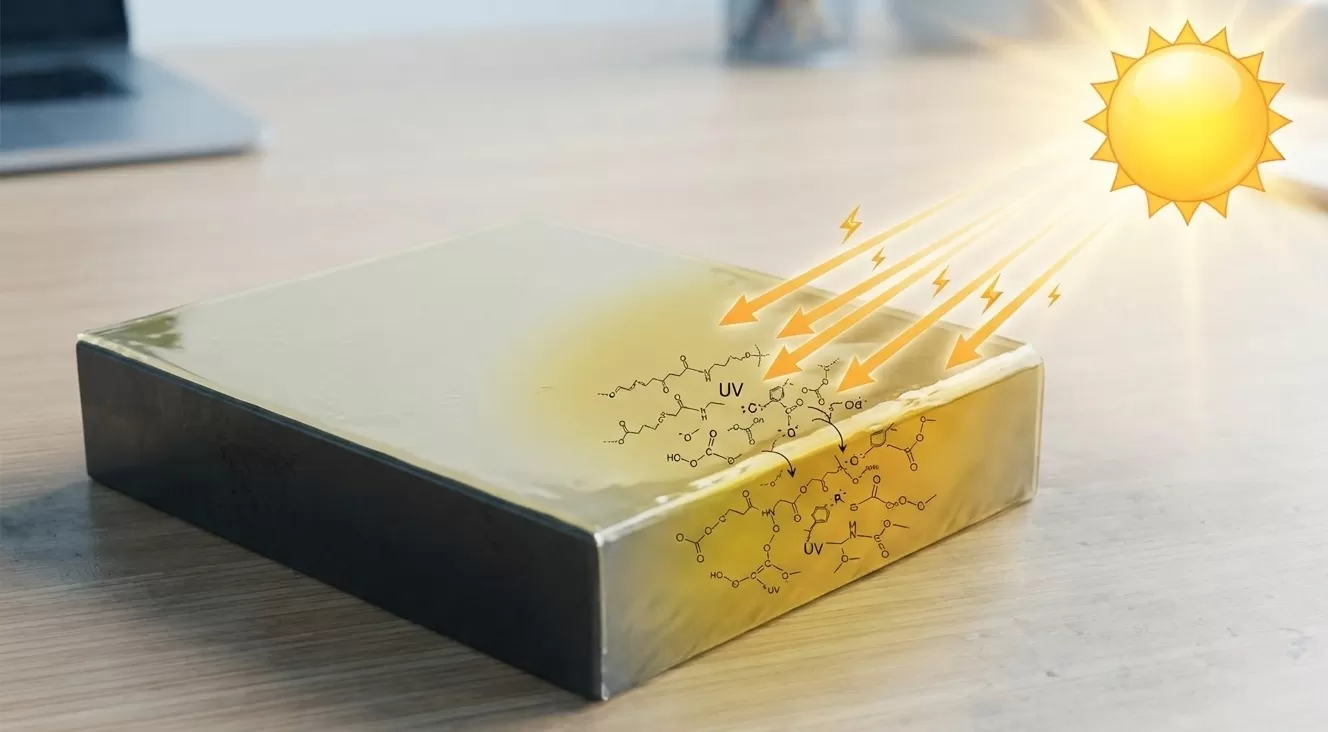
A suitable clearcoat layer can help the paint system increase its resistance to UV rays, chemicals, dirt and light mechanical impacts. Clearcoat also significantly determines the deep gloss feel and final aesthetic quality of the vehicle.
2K POLYURETHANE GLOSS PAINT – POPULAR SPECIALIZED LINE
2K polyurethane (PU) gloss paint is one of the popular choices in professional auto repair paint. The 2K system usually includes plastic components and curing agents. When mixed in the specified ratio, a polymer network formation reaction will occur, giving the paint film good hardness and durability.
Compared to single-component clearcoats, the 2K system can provide better gloss, durability and chemical resistance when applied properly. However, use requires control of mixing ratios, mixture life, spray conditions and appropriate labor safety requirements.
1K GLOSS PAINT – A SIMPLE SOLUTION
1K gloss paint is a coating system that does not require mixing a separate curing agent before use. Thanks to its simpler application process, this paint can be selected for some repairs, touch-ups or applications that do not require the durability level of the 2K system.
However, when a coating with greater hardness, gloss and environmental resistance is required, the 2K clearcoat system is often preferred in professional retouching procedures. The choice of 1K or 2K still needs to be based on the specific requirements of the paint system and the manufacturer's technical instructions.
WATER-BASED AUTOMOBILE PAINT – A TREND OF GREATING INTEREST
Waterborne paint uses water as part of the dispersion medium/significantly replaces organic solvents in the formulation. In the modern automotive refinishing industry, waterborne basecoat is increasingly used in markets with strict requirements on VOC emissions.
A water-based paint system does not mean that the entire car paint system uses only water. In practice, waterborne basecoat is often combined with appropriate primers and clearcoats to form the complete system. This technology has the advantage of reducing solvent emissions but requires good control of temperature, humidity, airflow and evaporation time during construction.
SELF-GLOSSARY PAINT – SINGLE-STAGE URETHANE
Single-stage urethane is a paint system that combines color and gloss functions in the same coating system. This is different from the basecoat/clearcoat system, in which the color layer and gloss layer are separated.
Single-stage urethane has the advantage of being a simpler process by eliminating the need for a separate clearcoat step in appropriate applications. However, the depth effect and the ability to create some special colors may not be the same as modern basecoat/clearcoat systems.
ANTI-SPLASH PAINT AND PROTECTIVE PAINT FOR UNDERBEARING AREA
In addition to the body paint system, cars also have specialized paints or coatings that are anti-kick, anti-abrasion and protect the underbody. Areas such as the undercarriage, wheel wells and lower body of the vehicle are often subject to strong impacts from water, mud, small rocks and chemicals on the road.
Specialized coatings for this area are often designed with the goal of protecting the substrate material rather than prioritizing gloss and color effects. Because working conditions are different from exterior surfaces, regular vehicle body paint should not be arbitrarily used as a substitute for specialized coating systems in areas subject to high impact and abrasion.
AUTOMOTIVE PLASTIC PAINT – TYPE OF PAINT FOR BURS AND POLYMER DETAILS
Many exterior details such as bumpers, mirror covers, handles, trim and some decorative details are made from plastic instead of metal. Therefore, paint for these parts needs to have suitable adhesion ability to the polymer substrate.
In these cases, the system may require the use of plastic adhesion promoters, plastic-specific primers, or products specifically designed for each type of substrate. If metal paint is used directly on certain plastics without appropriate surface treatment, the risk of peeling or loss of adhesion may be increased.
CAR PAINT SHOULD BE CHOOSED BY A SYSTEM INSTEAD OF INDIVIDUAL TYPES
A fairly common mistake is to only care about the "color paint" and ignore the compatibility between layers. In reality, a complete automotive paint system needs to consider the base material - primer - leveling layer - basecoat - clearcoat and corresponding thinners and curing agents.
For example, a paint system can be built in the direction of metal → epoxy primer → primer surfacer → basecoat → clearcoat. However, the actual structure may vary depending on manufacturing technology, vehicle condition and supplier instructions. The factory paint system may also have an additional anti-corrosion electrocoat layer before the primer.
THE ROLE OF PLASTIC IN AUTOMOTIVE PAINT
For manufacturers of paint and raw materials for automobile paint production, the choice of base resin is particularly important. The resin determines many properties of the paint film such as adhesion, hardness, gloss, chemical resistance, weather resistance and compatibility with other components.
Depending on each paint system, manufacturers can use different plastic bases such as acrylic, polyurethane, epoxy, polyester or modified plastic systems. Therefore, when researching car paint formulas, you should not only pay attention to the coloring pigment but also evaluate the entire binder/resin system, curing agent, solvent or water and accompanying additives.
HOW TO CHOOSE THE SUITABLE AUTOMOTIVE PAINT?
Choosing specialized car paint should first be based on the location to be painted and the base material. If processing bare metal, priority should be given to a primer system with adhesion and corrosion resistance; If you need to create a flat surface, primer surfacer will be more suitable. When needing to restore the car's color, basecoat is the component that determines the color, while clearcoat takes on most of the function of protecting and finishing the surface.
In addition, it is necessary to determine the requirements for gloss, UV resistance, chemical resistance, hardness, scratch resistance, construction conditions and environmental requirements. In particular, products that belong to the same technical system of the manufacturer or have been confirmed for compatibility should be used instead of arbitrarily combining many different types of paint.
CURRENT DEVELOPMENT TREND OF AUTOMOTIVE PAINTING
The automotive paint industry is aiming for paint systems with high durability, reduced VOC emissions, good UV resistance, scratch resistance and meet increasingly high aesthetic requirements. Water-based paint is one of the notable developments, especially for the basecoat layer in modern repair paint technology.
Besides traditional paint systems, the market also has specialized technologies such as scratch-resistant clearcoat, self-healing coatings and special protective coatings. However, these technologies often have higher technical requirements and costs, so the level of application depends on the vehicle segment and the processes of each manufacturing or repair facility.
It can be seen that specialized car paint is not simply a color coating on the outside of the car but is a multi-layer system, in which each type takes on a separate function. Popular lines include electrolytic paint, epoxy primer, primer surfacer, sealer, basecoat color paint, metallic paint, pearl paint, clearcoat 1K, clearcoat 2K, water-based paint and specialized coatings for plastic and undercarriage.
For paint manufacturing businesses, choosing the appropriate base resin, curing agent, pigment and additives will significantly determine the final quality of automotive paint. A good paint system not only needs beautiful color but also must have adhesion, gloss, hardness, UV resistance, chemical resistance and weather durability suitable for actual usage conditions.
>> See more Plastic for car paint <<
>> See more Sanmu 8170 plastic <<
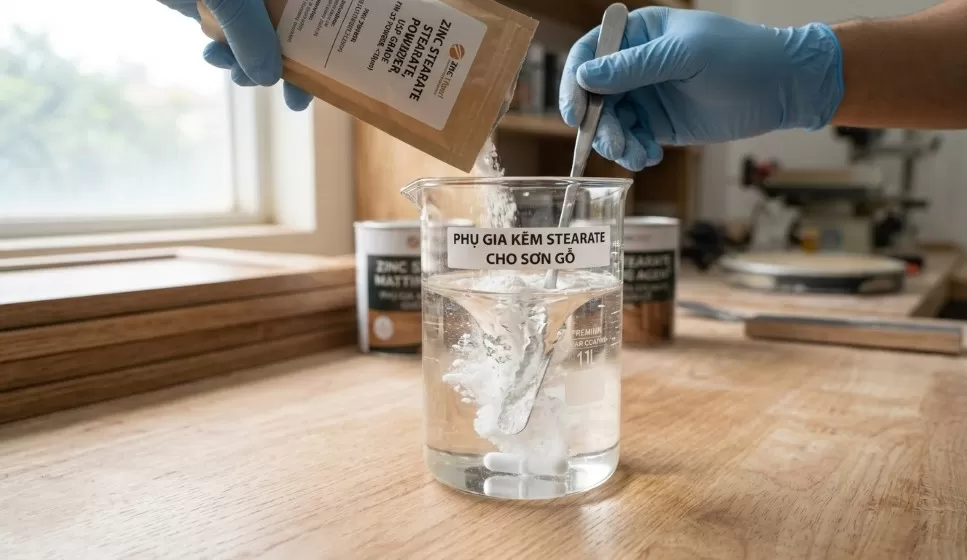
>> See more Zinc stearate (wood paint additive) <<
>> See more Epoxy resin <<
MEGA VIETNAM GENERAL TRADING COMPANY LIMITED
Address: Floor 2-A2-IA20, Nam Thang Long Urban Area, Ward. Pham Van Dong, Phu Thuong Ward, City. Hanoi.
Email: contact@megavietnam.vn; Tel: (+84) 24 375 89089;
Website: megavietnam.vn; Hotline: 1800.577.728; Zalo: 0971.023.523