WHAT IS TRAFFIC ROAD SIGNING?
Road marking paint is a specialized paint used to create direction lines, lane dividers, directional arrows, traffic symbols and warning signs on the road surface.
Unlike conventional paints, traffic paints must meet many technical requirements such as high adhesion on concrete or asphalt, abrasion resistance due to heavy vehicle traffic, weather resistance, long-lasting color retention and guaranteed reflectivity at night when combined with reflective glass beads.
POPULAR TYPES OF ROAD SIGNING PAINT
Currently, traffic paint is divided into three main groups.
Thermoplastic paint (Hot Melt Road Marking Paint) is a type commonly used on highways, national highways and routes with high vehicle density. The paint is heated to about 180–220°C before application, then quickly hardens upon contact with the road surface, creating a coating with great thickness, long life and good reflective particle retention.
Solvent-based paint Easier to construct, does not require hot cooking equipment and is often used for parking lots, internal roads, factories or works with average traffic volume.
Water-based paint is a current development trend thanks to its low VOC content, is more environmentally friendly and complies with many green building standards. However, this type of paint needs to be chosen in accordance with the climatic conditions and technical requirements of each project.
TECHNICAL REQUIREMENTS FOR ROAD SIGNING PAINT
A quality traffic paint system needs to meet many criteria simultaneously.
The paint layer must have good adhesion to limit peeling under the impact of wheels and weather. High abrasion resistance helps paint lines maintain their shape for a long time. In addition, reflectivity is a particularly important factor to increase visibility at night or when it rains.
In addition, the paint needs to be able to withstand UV rays, heat, and water, maintain stable color, and limit cracking when the pavement expands with temperature.
THE ROLE OF REFLECTIVE PARTICLES IN TRAFFIC PAINT
To make road markings easier to see at night, traffic paint is often combined with reflective glass beads (Glass Beads).
These particles reflect light from the vehicle's headlights back to the driver, making the paint lines brighter in low light conditions. For thermoplastic paint, a part of the reflective granules is pre-mixed in the paint mixture, and another amount is spread on the surface immediately after application to optimize the reflective effect.
APPLICATIONS OF ROAD LINE PAINT
Traffic paint is used in many different categories such as highways, national highways, urban roads, airports, seaports, industrial parks, parking lots, logistics centers, factories and warehouses.
In addition to traditional lane markings, paint is also used to create speed limit signs, directional arrows, pedestrian areas, bicycle lanes, no-parking zones and many other safety indication systems.
FACTORS AFFECTING THE LIFESPAN OF SON KE DUONG
The lifespan of the paint layer not only depends on the quality of the material but is also influenced by many factors such as vehicle traffic, vehicle load, climatic conditions, road surface quality and construction process.
If the application temperature is not suitable or the surface has not been thoroughly cleaned, adhesion will be significantly reduced. Besides, choosing the right type of adhesive resin, pigment, filler and reflective particles also directly determines the longevity of the paint line.
C5 HYDROCARBON PLASTIC – IMPORTANT INGREDIENT IN THERMOPLASTIC ROAD SIGNING PAINT
In the thermoplastic road marking formula, C5 Hydrocarbon resin acts as a binder, helping to bond ingredients such as pigments, fillers and reflective particles into a durable coating.
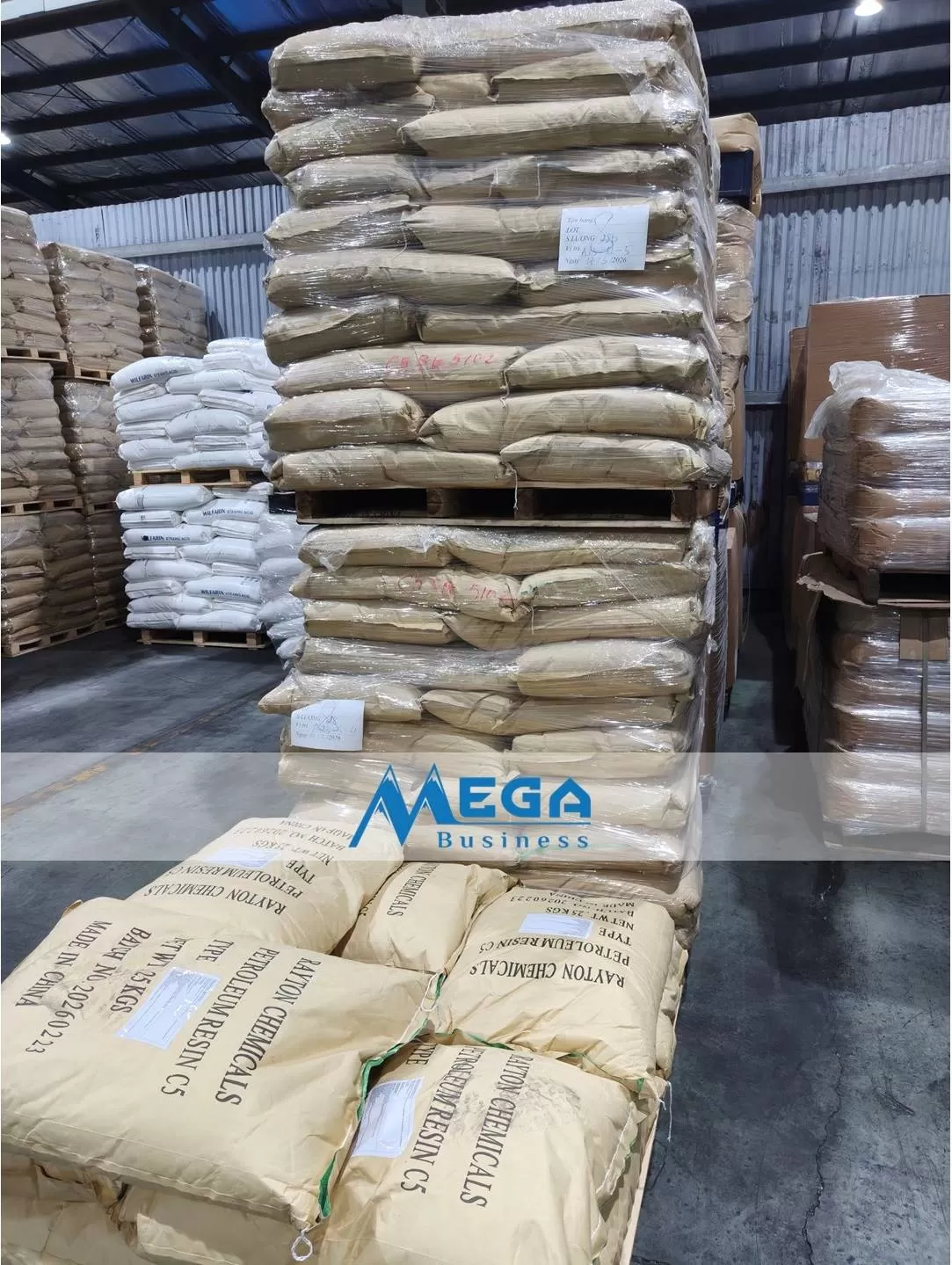
One of the commonly used products today is Petroleum Resin C5 SG-5101. This is a high purity C5 Hydrocarbon resin, clear yellow granular, low melting viscosity, good miscibility with EVA, resin and many other plastic systems.
When included in thermoplastic paint formulations, SG-5101 helps increase adhesion to the road surface, improve gloss, improve abrasion resistance, heat stability and maintain the color fastness of the paint layer in outdoor conditions. At the same time, plastic also helps keep reflective particles firmly attached to the surface, contributing to improving the ability to recognize road markings at night.
If you are looking for details about this material line, please refer to the product Petroleum resin C5 SG-5101 for road marking paint at Mega Vietnam.
DEVELOPMENT TREND OF TRAFFIC PAINT
Along with the development of smart transportation infrastructure, road marking paints are also continuously improved to increase longevity and reduce maintenance costs.
Many modern paint systems are supplemented with high-quality resins, anti-aging additives, high-performance reflective materials and environmentally friendly technology. At the same time, optimizing the adhesive resin formula such as Hydrocarbon C5, EVA and specialized additives also contribute to improving efficiency in increasingly harsh traffic conditions.
Painting traffic roads not only creates a visual guidance system but also makes an important contribution to ensuring safety and improving the operational capacity of the traffic system. Choosing the right type of paint and quality materials such as Hydrocarbon C5 resin will help increase the durability, adhesion, reflective efficiency and longevity of the paint line. In the context of increasingly high requirements for infrastructure quality, investing in quality traffic paint materials is a solution that brings long-term efficiency both technically and economically.
>> See more Hydrocarbon resin C5 <<
>> See more Hydrocarbon resin C9 <<
>> See more Petroleum C9 resin <<
>> See more Epoxy resin <<
MEGA VIETNAM GENERAL TRADING COMPANY LIMITED
Address: Floor 2-A2-IA20, Nam Thang Long Urban Area, Ward. Pham Van Dong, Phu Thuong Ward, City. Hanoi.
Email: contact@megavietnam.vn; Tel: (+84) 24 375 89089;
Website: megavietnam.vn; Hotline: 1800.577.728; Zalo: 0971.023.523