WHAT IS NATURAL RUBBER?
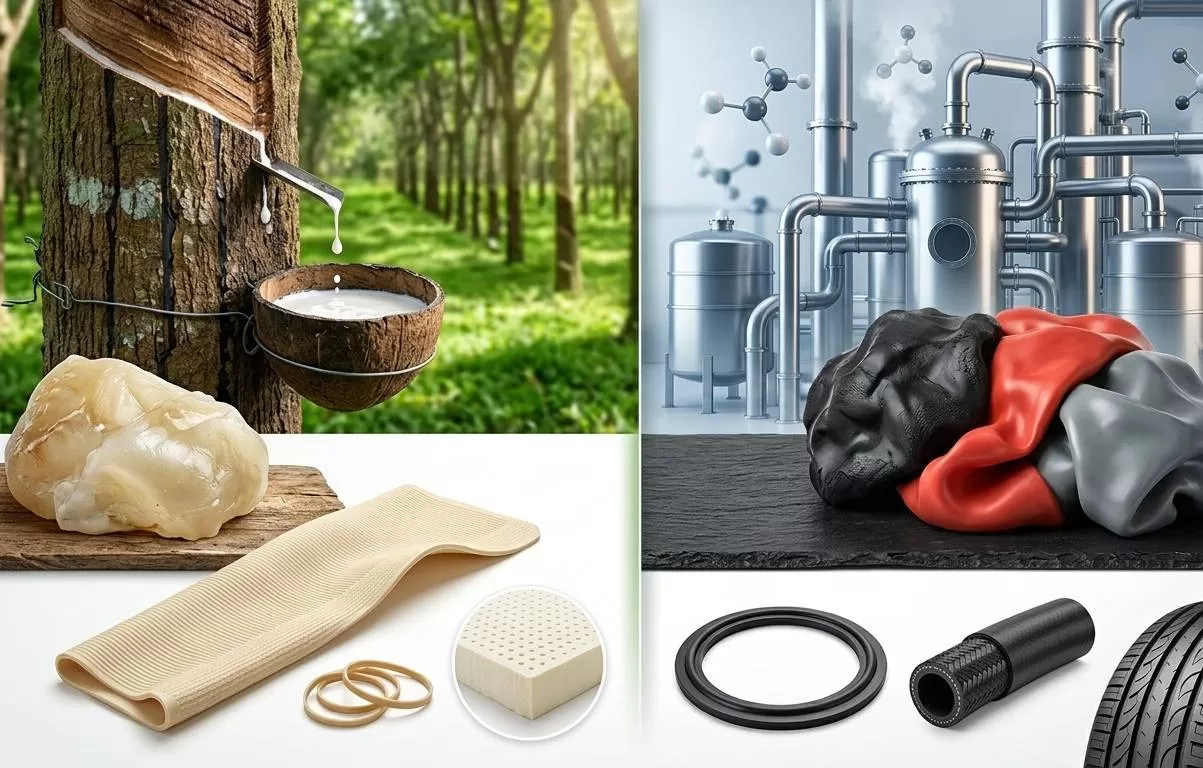
Natural Rubber (NR) is produced from the latex of the rubber tree (Hevea brasiliensis). After harvesting, rubber latex is processed, concentrated or coagulated to form raw materials for production.
The main component of natural rubber is polyisoprene cis-1,4, which provides very high elasticity, good tensile strength and outstanding fatigue resistance. Thanks to these properties, natural rubber remains an irreplaceable material in many applications that require elasticity and the ability to withstand large deformations.
WHAT IS SYNTHETIC RUBBER?
Synthetic Rubber is produced through chemical synthesis from raw materials derived from petroleum or natural gas.
Unlike natural rubber which has only one main ingredient, synthetic rubber includes many different types such as SBR (Styrene Butadiene Rubber), BR (Butadiene Rubber), NBR (Nitrile Butadiene Rubber), EPDM (Ethylene Propylene Diene Monomer), CR (Chloroprene Rubber), Silicone Rubber, FKM (Fluoroelastomer) and many other types of technical rubber.
Each type is developed to meet specific requirements for heat resistance, oil resistance, chemical resistance or aging resistance.
ORIGIN OF MATERIALS
The first difference lies in the source of raw materials.
Natural rubber is a material of biological origin, exploited directly from rubber trees. This is a renewable source of raw materials through tree planting and exploitation.
Meanwhile, synthetic rubber is produced using petrochemical technology, using monomers such as butadiene, styrene, acrylonitrile or other organic compounds to form the required polymer.
RESILIENCE AND MECHANICAL DURABILITY
Natural rubber is famous for its very high elasticity, high tensile strength and outstanding fatigue resistance. Therefore, this material is often used in truck tires, construction tires, bridge bearings, shock absorbers and products subject to dynamic loads.
Meanwhile, many types of synthetic rubber have lower elasticity but are optimized to meet special requirements such as abrasion resistance, heat resistance or oil resistance.
HEAT RESISTANCE
This is where synthetic rubber often dominates.
Natural rubber works well in medium temperatures but will age quickly when working long-term at high temperatures.
In contrast, many types of synthetic rubber such as EPDM, Silicone or FKM can work stably in very high or very low temperature environments, suitable for the automotive, aviation and chemical industries.
RESISTANT TO OIL AND CHEMICAL
Natural rubber is not resistant to mineral oils and many organic solvents. With prolonged exposure to oil or fuel, the material can swell and lose its mechanical properties.
Meanwhile, synthetic rubbers such as NBR or FKM are specifically developed to work in environments with grease, fuel, chemicals or industrial solvents.
OUTDOOR ANTI-AGING RESISTANCE
If used outdoors for a long time, natural rubber is easily affected by UV rays, ozone and oxidation if not supplemented with appropriate anti-aging additives.
In contrast, many types of synthetic rubber such as EPDM have very good resistance to UV rays, ozone and weather, so they are often used for door seals, awnings, waterproofing systems and outdoor products.
PRICE AND ECONOMIC EFFICIENCY
The price of natural rubber depends heavily on mining output, weather conditions and fluctuations in the global agricultural market.
Synthetic rubber is affected by oil prices and chemical costs. Depending on the type, some synthetic rubbers cost less than natural rubber, while high-end technical rubbers such as Silicone or FKM can cost significantly more.
Therefore, material selection is not only based on raw material prices but also needs to consider product life, working conditions and operating costs throughout the life cycle.
WHEN SHOULD YOU CHOOSE NATURAL RUBBER?
Natural rubber is the right choice when the product requires high elasticity, good fatigue resistance, high tensile strength and effective vibration absorption.
Typical applications include truck tires, conveyor belts, belts, bridge bearings, shock absorbers, rubber gloves, rubber cushions and many products subject to dynamic loads.
WHEN SHOULD YOU CHOOSE SYNTHETIC RUBBER?
Synthetic rubber is suitable for applications that require specialized features such as oil resistance, fuel resistance, chemical resistance, high heat resistance or working outdoors for long periods of time.
This is a material widely used in engine gaskets, oil seals, fuel pipes, electrical cables, auto components, industrial equipment, HVAC systems and many modern technical products.
DEVELOPMENT TRENDS OF THE RUBBER INDUSTRY
Currently, the rubber industry is tending to combine natural rubber and synthetic rubber to take advantage of the advantages of both materials. In addition, additive systems such as carbon black, silica, antioxidants, anti-ozone agents and heat stabilizers are also researched and optimized to improve the longevity, anti-aging ability and performance of rubber products.
At the same time, many businesses are also developing bio-rubber lines and environmentally friendly materials to reduce dependence on petrochemical raw materials, meeting the sustainable development requirements of the materials industry.
Natural rubber and synthetic rubber both play an important role in modern industry, but each type has its own advantages. Natural rubber stands out for its elasticity, tensile strength and fatigue resistance, while synthetic rubber excels in heat resistance, oil resistance, chemical resistance and outdoor aging resistance. Choosing the right type of rubber should be based on actual working conditions, technical requirements and cost optimization goals to achieve long-term performance.
>> See more Additives for rubber <<
>> See more Melamine flame retardant additive <<
>> See more Epoxy resin <<
MEGA VIETNAM GENERAL TRADING COMPANY LIMITED
Address: Floor 2-A2-IA20, Nam Thang Long Urban Area, Ward. Pham Van Dong, Phu Thuong Ward, City. Hanoi.
Email: contact@megavietnam.vn; Tel: (+84) 24 375 89089;
Website: megavietnam.vn; Hotline: 1800.577.728; Zalo: 0971.023.523