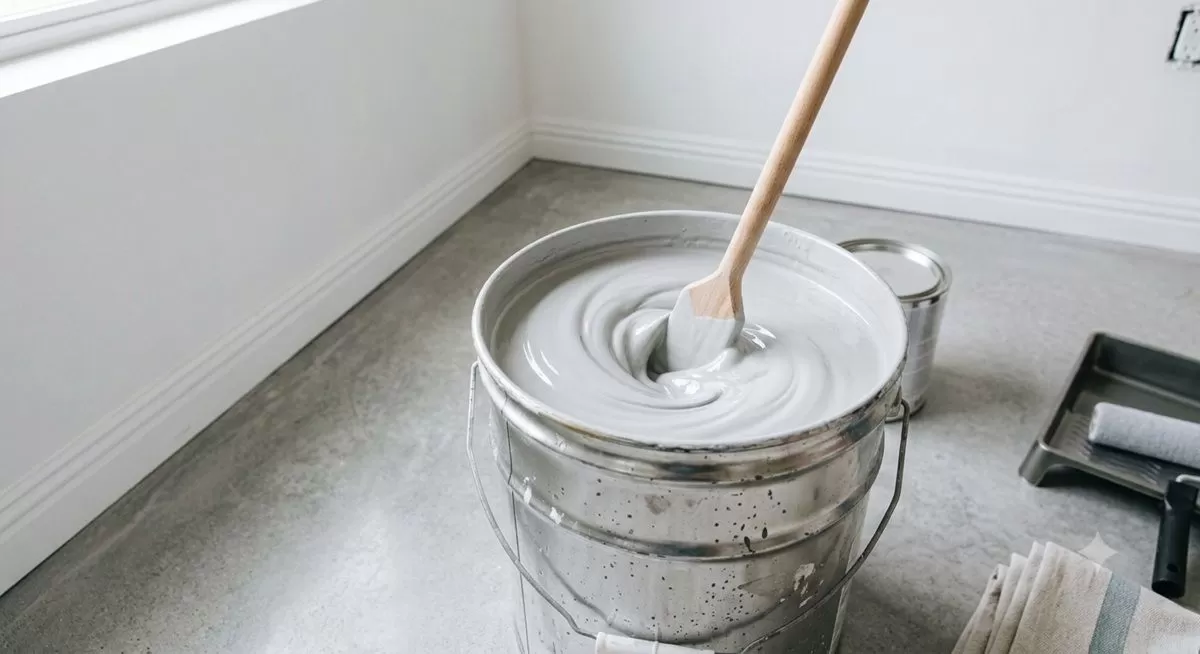
Viscosity not only affects the production process but also directly affects the workability, paint film quality and effectiveness of the product. So how does the viscosity of epoxy resin affect the paint preparation process?
WHAT IS THE VISCOSITY OF EPOXY RESIN?
Viscosity is a quantity that represents the degree of resistance to flow of a liquid. For epoxy resins, viscosity reflects the ability to flow and how thick or thin the resin is at a certain temperature.
Epoxy resin can exist in many different forms:
- Low viscosity epoxy resin.
- Medium viscosity epoxy resin.
- High viscosity epoxy resin.
- Solid or semi-solid epoxy resin.
Depending on the intended use, the manufacturer will choose a resin with the appropriate viscosity to optimize the production process and performance of the paint.
EFFECT OF VISCOSITY ON POWDER DISPERSION PROCESS
In the process of grinding and dispersing pigments, the viscosity of epoxy resin plays a very important role.
When viscosity is too low:
- Color particles easily settle to the bottom of the device.
- Crushing force transmission efficiency is reduced.
- Poor pigment dispersion ability.
- Layering phenomenon can easily arise during storage.
When the viscosity is too high:
- Difficult to mix and grind to disperse.
- Increase energy consumption for the device.
- Reduce the performance of the crusher.
- Pigment clumping may occur.
A suitable level of viscosity will help pigment to be dispersed evenly, create stable color and improve paint film quality.
AFFECTS THE ABILITY TO MIX INGREDIENTS
In epoxy paint formulas there are often many ingredients such as:
- Epoxy resin.
- Curing agent.
- Color powder.
- Filling powder.
- Solvent.
- Anti-sediment additives.
- Dispersing additives.
- Anti-foam additives.
If the epoxy resin has too high viscosity, the mixing process will be difficult because the ingredients will be difficult to mix evenly. Conversely, if the viscosity is too low, the mixture may become unstable, increasing the risk of sedimentation or layering during storage.
EFFECT ON SOLID CONTENT OF PAINT
The viscosity of epoxy resin is closely related to the ability to build paint formulations with high solids content.
Low viscosity epoxies often allow:
- Reduce the amount of solvent used.
- Increase solid content.
- Reduces volatile organic compound (VOC) emissions.
- Meet increasingly stringent environmental requirements.
This is why many modern epoxy coating systems prefer to use low viscosity liquid epoxy resin or modified epoxy.
EFFECTS ON CONSTRUCTION POSSIBILITY
Viscosity directly affects the paint application method.
For spray paint:
Paint needs to have the right viscosity to create a stable spray mist, limit nozzle clogging, and ensure a uniform surface finish.
If the viscosity is too high, the paint will be difficult to spray and will easily create a rough surface. If it's too low, the paint film will easily sag.
For roller or brush painting:
Appropriate viscosity helps paint adhere well to the surface, limit dripping, and easily control paint film thickness.
EFFECTS ON PAINT FILM THICKNESS
Viscosity is one of the factors that determine the film-forming ability of paint.
High viscosity epoxy resins often help:
- Increase paint film thickness after each coat.
- Reduce the number of paint layers that need to be applied.
- Improved anti-corrosion protection.
However, if the viscosity is too high, defects such as orange skin, uneven flow, air bubbles, and uneven paint film may appear.
Therefore, it is necessary to balance between viscosity and actual construction requirements.
EFFECTS ON RESISTANCE ABILITY
In paint systems containing many pigments and fillers, viscosity contributes to maintaining product stability during storage.
Epoxy resin with suitable viscosity helps:
- Reduces pigment settling rate.
- Limit the phenomenon of caking on the bottom of the barrel.
- Easy to stir again before use.
This is especially important for anti-corrosion epoxy paints containing high pigment content.
HOW TO CHOOSE THE SUITABLE EPOXY VISCOSITY
There is no one viscosity value suitable for all types of paint. The selection should be based on:
Paint Type: Self-leveling epoxy paint, anti-corrosion epoxy paint, floor coating epoxy paint, marine epoxy paint, chemical resistant epoxy paint.
Construction method: Pressure spraying, air spraying, rolling, sweeping, self-leveling pouring.
Desired solids content: High solids paint formulations often favor low viscosity epoxy resins to reduce the need for solvents.
The viscosity of epoxy resin is a technical parameter that greatly affects the entire paint preparation process, from pigment dispersion, raw material mixing, product stability to workability and paint film quality after curing. Choosing epoxy resin with appropriate viscosity will help optimize the production process, improve construction efficiency and ensure the protective properties of the finished paint layer.
For paint manufacturers, understanding the relationship between viscosity and formulation performance is an important factor in creating high-quality products that meet the increasingly stringent technical and environmental requirements of the market.
>> See more Epoxy resin <<
>> See more Epoxy curing <<
>> See more Epoxy resin YD 011X75 <<
>> See more Epoxy resin KER 3001X75 <<
MEGA VIETNAM GENERAL TRADING COMPANY LIMITED
Address: Floor 2-A2-IA20, Nam Thang Long Urban Area, Ward. Pham Van Dong, Phu Thuong Ward, City. Hanoi.
Email: contact@megavietnam.vn; Tel: (+84) 24 375 89089;
Website: megavietnam.vn; Hotline: 1800.577.728; Zalo: 0971.023.523