COMPARE EPOXY PLASTIC AND POLYESTER PLASTIC
Epoxy resin is a thermosetting resin formed from the reaction between epoxy resin and hardener. Once the reaction is complete, the resulting material has a very tightly bonded structure, providing high hardness, mechanical strength and chemical resistance. This is why epoxy is often used in applications that require high quality such as industrial flooring, structural adhesives, high-end composites, electronics and anti-corrosion.
Meanwhile, polyester resin is a thermosetting resin synthesized from the reaction between organic acids and polyfunctional alcohols. Polyester is often cured with MEKP catalyst to form a hard material. The biggest advantage of polyester is its low price, ease of construction and fast curing time, so it is widely used in the production of civil composites, tanks, boats, statues, FRP furniture and many common industrial products.
1. Adhesion
The first difference between epoxy resin and polyester resin lies in adhesion. Epoxy is famous for its extremely strong adhesion on many surfaces such as metal, concrete, wood, stone, glass and old composites. This helps epoxy to be widely used in the fields of structural repair, protective coatings and technical adhesives. Meanwhile, polyester has significantly lower adhesion, especially on metal or concrete surfaces, so it is often more suitable for new molded products rather than repairs or structural bonding.
2. Mechanical durability
In terms of mechanical strength, epoxy is also superior to polyester. After curing, epoxy material has high hardness, good strength, impact resistance and is less prone to cracking. Although polyester also has a certain hardness, it is more brittle and susceptible to shrinkage during the curing process. Therefore, products that require high stability or long lifespan often prefer to use epoxy.
3. Water and chemical resistance
Water resistance and chemical resistance are also factors that make a clear difference. Epoxy resin has a tightly bonded structure so it has very good waterproofing ability, little water absorption and resistance to many industrial chemicals. This is why epoxy is often used for factory floors, chemical tanks, ships or anti-corrosion coatings. Polyester is quite resistant to water, but if exposed to moisture or strong chemicals for a long time, its durability will decrease faster than epoxy.
4. Shrinkage when curing
Another important point is curing shrinkage. Epoxy has very low shrinkage, so the finished surface is stable, less warping and limits cracking. Meanwhile, polyester typically shrinks more during the curing process, which can affect the dimensional accuracy of the composite product or coating.
5. Aesthetics
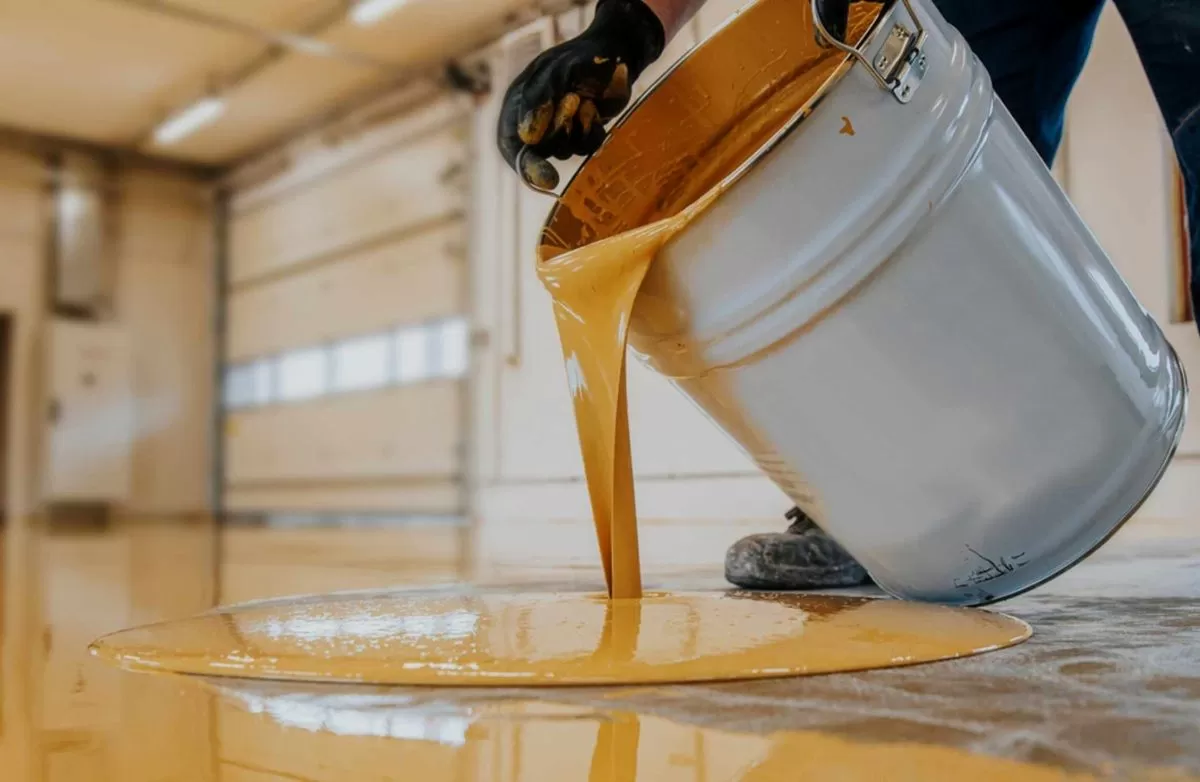
In terms of aesthetics, both epoxy and polyester can create beautiful glossy surfaces. However, epoxy often provides a more transparent coating, high gloss and good self-leveling ability, so it is very popular in resin table top applications, art epoxy floors or high-end protective coatings. Polyester can yellow more rapidly when exposed to UV rays without appropriate UV protection additives.
6. Heat resistance
In terms of heat resistance, polyester can withstand heat quite well in some common applications, but epoxy is often more stable in constantly changing temperature environments. In addition, epoxy also has good electrical insulating properties so it is widely used in the electrical - electronic industry and as technical insulating materials.
WHY IS POLYESTER PLASTIC STILL WIDELY USED?
One of the factors that makes polyester still widely used is cost. Polyester resin is often significantly cheaper than epoxy, the materials are easy to find and the construction process is simpler. This makes polyester a popular choice for mass-produced products or projects that need to optimize costs. In contrast, epoxy costs more but in return comes superior performance and durability.
Regarding odor and safety during construction, polyester often has a quite strong odor due to containing styrene, easily causing discomfort if working in closed spaces. Epoxy tends to have less odor, but protective gear is still needed because the curing ingredients can cause skin irritation if exposed directly.
PRACTICAL APPLICATION OF EPOXY PLASTIC AND POLYESTER PLASTIC
In the field of practical applications, epoxy is often used for industrial floor paints, structural adhesives, high-end composites, anti-corrosion coatings, electronic circuit boards, epoxy resin tables and projects that require long life (for example, Epoxy resin YD 011X75. Polyester is popular in the production of FRP boats, composite tanks, light roofs, composite statues, civil components and products that need to optimize production costs.
It can be seen that epoxy and polyester both have their own advantages. If you need a material with high durability, good water resistance, strong adhesion and long lifespan, epoxy is a more suitable choice. On the contrary, if low cost, quick construction and large quantity production are prioritized, polyester will be a more economical solution.
When choosing between epoxy resin and polyester resin, users should consider the usage environment, technical requirements, desired lifespan as well as investment budget. Choosing the right material not only helps optimize efficiency but also improves the durability and quality of the product or project.
>> See details Epoxy resin <<
>> See more Epoxy resin YD 011X75 <<
>> See more Plastic for anti-rust paint <<
>> See more Longoil alkyd resin <<
MEGA VIETNAM GENERAL TRADING COMPANY LIMITED
Address: Floor 2-A2-IA20, Nam Thang Long Urban Area, Ward. Pham Van Dong, Phu Thuong Ward, City. Hanoi.
Email: contact@megavietnam.vn; Tel: (+84) 24 375 89089;
Website: megavietnam.vn; Hotline: 1800.577.728; Zalo: 0971.023.523