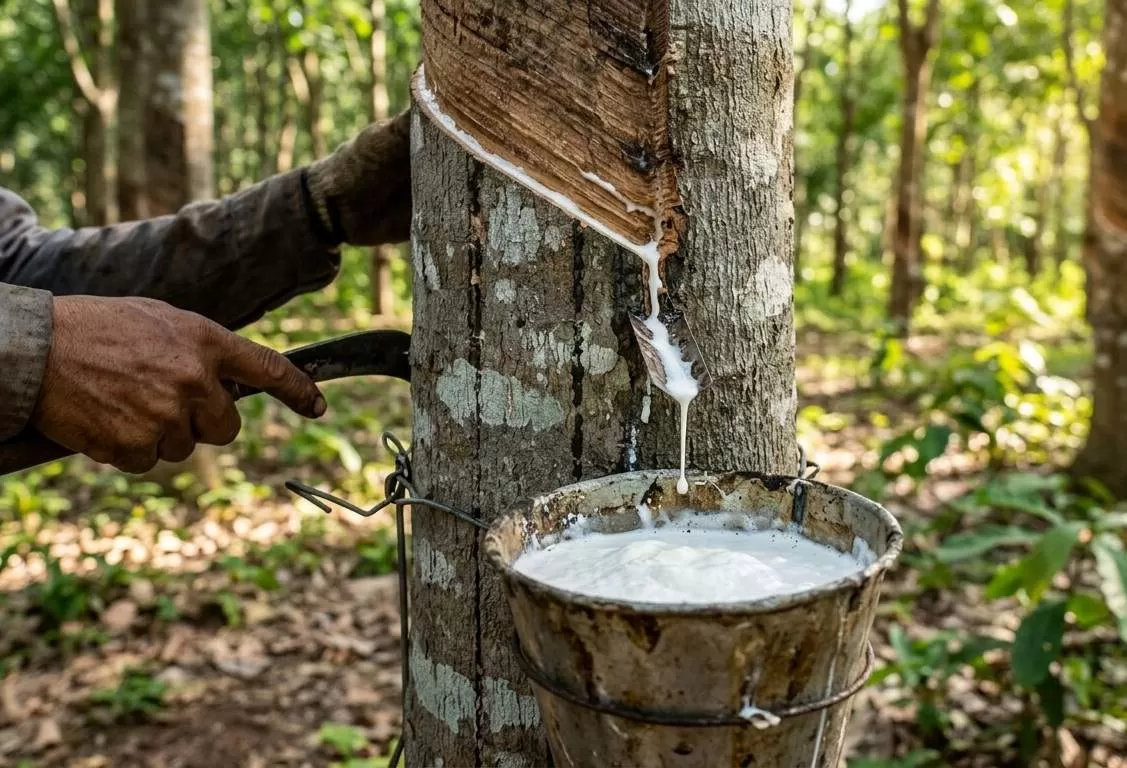
Vulcanization is considered one of the most important inventions in the history of the rubber industry. Before being vulcanized, natural rubber has many disadvantages such as being soft at high temperatures, brittle and hard at low temperatures, and quickly degrading under the impact of the environment. After the vulcanization process, these properties are significantly improved, helping rubber become an engineering material widely used in many fields.
HISTORY OF RUBBER VULCULATION TECHNOLOGY
In 1839, American inventor Charles Goodyear discovered the vulcanization phenomenon when he accidentally heated a mixture of rubber and sulfur. He found that the resulting material had superior elasticity and durability compared to the original natural rubber.
This invention created a revolution in the rubber manufacturing industry, paving the way for the production of tires, seals, belts, anti-vibration pads and thousands of other technical products.
Today, although many advanced vulcanization technologies have appeared, the basic principle of the vulcanization process is still based on the formation of cross-links between polymer molecules.
PRINCIPLES OF RUBBER VULZATION REACTION
Natural rubber and most synthetic rubbers have a long chain polymer structure. These polymer chains can slide over each other when subjected to force, causing the material to easily deform.
During the vulcanization process, sulfur atoms or other vulcanizing agents create bridges between the polymer chains. These bridges are called crosslinks.
As the number of cross-links increases:
- Increased tensile strength.
- Increased elasticity.
- Improved wear resistance.
- Better chemical resistance.
- Higher thermal stability.
- Reduce residual deformation after loading.
Thanks to that, rubber materials can meet strict requirements in industry and life.
MECHANISM OF VULZATION REACTION WITH SULFUR
Sulfur is the most popular vulcanizing agent today.
Under heating conditions from about 140°C to 180°C, sulfur reacts with the double bonds present in the rubber polymer structure, forming sulfur bridges between molecular chains.
This process usually takes place with the support of:
- Accelerator.
- Activator.
- Antioxidants.
- Heat stabilizer.
These additives help speed up reactions, reduce processing time and improve final product quality.
Depending on technological conditions, cross-linking can exist in the form of:
- Monosulfide bond (-S-).
- Disulfide bond (-S-S-).
- Polysulfide bond (-Sx-).
Each type of bond brings different mechanical and thermal properties to the rubber product.
COMMON METHODS OF RUBBER VULCULATION
1. Vulcanization with sulfur
This is the most widely used method in the rubber manufacturing industry.
Advantages: Low cost, easy to deploy, creates good elasticity, suitable for many types of rubber.
Applications: Tires, inner tubes, rubber gaskets, shoe soles, conveyor belts.
2. Vulcanize with peroxide
Peroxide forms carbon-carbon bonds instead of sulfur bonds.
Advantages: Good heat resistance, high aging resistance, good chemical resistance.
Applications: Electric cables, heat-resistant gaskets, high-quality technical rubber.
3. Vulcanization by radiation
This method uses gamma rays or electron beams to create cross-linking.
Advantages: No need for sulfur, precise control of bond density.
Application: Medical materials, specialized rubber, high technology.
4. Vulcanization with metal oxide
Applicable to some special types of rubber such as chloroprene rubber.
Advantages: Increased oil resistance, good chemical resistance.
Application: Industrial seals, gaskets subject to harsh environments.
FACTORS AFFECTING THE VULCULATION PROCESS
The quality of the vulcanization reaction depends on many different technical factors.
- Temperature
The higher the temperature, the faster the reaction rate. However, if the temperature is too high, it can cause rubber to burn or destroy the polymer structure.
- Vulcanization time
Too short a time leads to incomplete vulcanization. Too long a time can cause excessive vulcanization, reducing elasticity.
- Sulfur content
The amount of sulfur determines the cross-link density in the material. Low content makes rubber softer and more elastic. High content makes rubber harder and more resistant to abrasion.
- Type of vulcanization accelerator
Quality vulcanization promotion helps shorten production time and optimize product mechanical properties.
- Rubber type
Each type of rubber has different reactivity: Natural rubber (NR), SBR rubber, NBR rubber, EPDM rubber, CR rubber, Silicone rubber.
Therefore, the vulcanization formula needs to be designed to suit each type of material.
ROLE OF VULZATION REACTION IN INDUSTRY
The vulcanization reaction is the decisive step to the final quality of rubber products.
Thanks to this process, rubber materials can achieve:
- High elasticity.
- Great tensile strength.
- Abrasion resistance.
- Heat resistance.
- Resistant to oils and chemicals.
- Longer service life.
Without the vulcanization process, most modern rubber products would not be able to meet the technical requirements of industries.
APPLICATIONS OF VULCIZED RUBBER
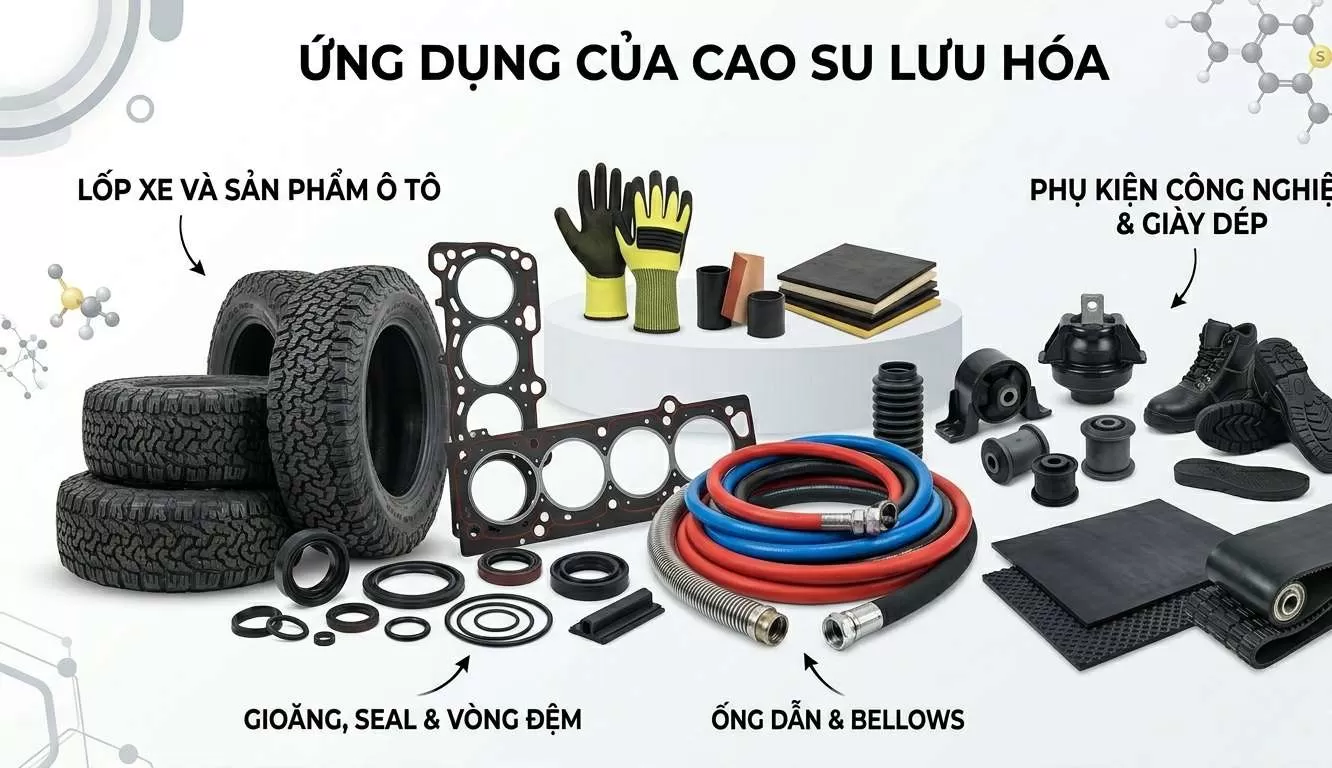
Today, vulcanized rubber is used in almost all fields of production and life. Some typical applications include:
- Car and motorbike tires.
- Industrial sealing gaskets.
- Transmission belt.
- Industrial conveyor belts.
- Shoe soles and consumer products.
- Electric cables.
- Medical equipment.
- Anti-vibration components.
- Aviation and defense spare parts.
The development of vulcanization technology continues to play an important role in improving the performance and durability of modern rubber products.
Rubber vulcanization reaction is the process of creating cross-linking between polymer chains to significantly improve the mechanical, thermal and chemical properties of rubber materials. This is the foundation technology of the modern rubber industry, helping to create products with high durability, good elasticity and the ability to work in many harsh conditions. Understanding the mechanism and factors affecting the vulcanization process helps businesses optimize product quality, improve production efficiency and better meet technical requirements in practice.
>> See more Promote vulcanization <<
>> See more MBT vulcanization promotion (M) <<
>> See more Vulcanizing agent <<
>> See more Epoxy resin <<
MEGA VIETNAM GENERAL TRADING COMPANY LIMITED
Address: Floor 2-A2-IA20, Nam Thang Long Urban Area, Ward. Pham Van Dong, Phu Thuong Ward, City. Hanoi.
Email: contact@megavietnam.vn; Tel: (+84) 24 375 89089;
Website: megavietnam.vn; Hotline: 1800.577.728; Zalo: 0971.023.523